Insurance Denied Remicade? How to Appeal and Get Covered

Your doctor prescribed Remicade because your condition requires a powerful, proven biologic delivered directly into your bloodstream. Unfortunately, your insurer disagreed. If you’re feeling stuck, don’t be. This guide walks you through exactly how to push back and win.
Remicade (infliximab) has been treating serious autoimmune conditions since its initial FDA approval in 1998. It was the first TNF inhibitor ever approved by the FDA, and it remains a frontline therapy for Crohn’s disease, ulcerative colitis, rheumatoid arthritis, psoriatic arthritis, ankylosing spondylitis, and plaque psoriasis. Doctors prescribe it because it works, often when other treatments haven’t.
But insurers have been aggressively steering patients away from brand Remicade and toward biosimilars like Inflectra, Renflexis, and Avsola, and in many cases denying coverage for infliximab entirely until patients clear a gauntlet of prior authorization requirements.
Here’s what the insurance industry doesn’t expect: for you to fight back. Fewer than 1% of denied claims are ever appealed, which saves insurers billions every year. But that statistic reflects how confusing the process is, not how hopeless it is. When patients appeal with solid clinical evidence and the right strategy, overturn rates are dramatically higher. Claimable’s appeals succeed over 80% of the time in established conditions.
Remicade denials are more complicated than most because the drug triggers several types of coverage disputes at once, and the strategy for overturning one type looks nothing like another. This guide covers all of them.
Why Insurance Companies Deny Remicade Coverage
Before you respond to a denial, identify exactly what type you’re dealing with. The evidence you’ll need and the escalation strategy you follow depend entirely on the specific reason your insurer said no. Submitting the wrong type of response wastes time and can exhaust your limited appeal opportunities.
What Makes Remicade Denials Unique
Remicade sits at the intersection of several insurance pressure points that don’t apply to most medications. It’s an IV infusion billed through your medical benefit (not your pharmacy benefit), which opens the door to site-of-care restrictions and benefit-routing errors on top of standard coverage disputes. It has three commercially available biosimilars (Inflectra, Renflexis, and Avsola), and major insurers now require patients to try a biosimilar before they’ll cover brand Remicade. It treats six different autoimmune conditions with completely different step therapy rules. And dose escalation is common, especially for IBD patients, meaning your insurer may approve infliximab at one dose but deny the dose your doctor actually prescribed.
Understanding Your Denial
Denial letters are written in insurer language designed to sound final. They’re not. Here’s how to decode the most common denial types, what they actually mean for your situation, and where to start:
Biosimilar Switch and Formulary Change Denials
This is the denial type generating the most frustration right now. Your insurer isn’t saying you don’t need infliximab. They’re saying they’d rather pay for a different version of it.
Biosimilars are clinically similar to Remicade, and for patients starting infliximab for the first time, a biosimilar may work just fine. But switching a stable patient introduces real variables. Differences in formulation and manufacturing can affect how a biologic behaves in your body, and while clinical studies like the NOR-SWITCH trial have not confirmed increased immunogenicity from switching, the concern remains a recognized consideration in clinical practice. A 2025 study in Gastro Hep Advances found that IBD patients denied biologic therapy had worse clinical outcomes, higher hospitalization rates, and a trend toward more ER visits in the year following denial.
The arguments that win: documented adverse reactions to a biosimilar’s formulation or delivery, a history of disease flares or loss of response during prior medication switches, immunogenicity concerns supported by anti-drug antibody testing, and clinical stability on brand Remicade demonstrated by objective disease activity scores and lab values.
State protections worth checking: several states have enacted non-medical switching laws that may limit your insurer’s ability to force you off a stable biologic for purely cost-driven reasons. If your state has these protections, reference them directly in your appeal. (Related: How to Get a Non-Formulary Drug Covered)
Step Therapy Required
Step therapy is the insurer’s way of making you prove that cheaper options failed before they’ll pay for the one your doctor actually prescribed. For Remicade, that means failing on different drugs depending on your diagnosis:
The critical detail most patients miss: “failure” has a broad medical definition that works in your favor. Side effects, contraindications, and medical reasons a drug is inappropriate all count. Methotrexate, for example, is contraindicated in pregnancy and in patients with chronic liver disease. If a required step therapy drug isn’t appropriate for you, document that in your appeal.
The argument that wins: The 2025 ACG guidelines for Crohn’s disease explicitly recommend against the traditional step-up approach and support early use of advanced therapies, including infliximab, for moderate-to-severe disease. The ACR’s 2021 RA guidelines support biologic therapy for patients who don’t reach their treatment target on conventional DMARDs. Citing these puts the insurer’s demand for additional steps in direct tension with the clinical evidence.
Not Medically Necessary
This denial rarely reflects a thorough clinical judgment. It usually means the PA submission was too thin, and it’s one of the most commonly overturned denial types on appeal. A strong resubmission includes disease severity documented with objective measures (CDAI for Crohn’s, partial Mayo for UC, DAS28 for RA, PASI or BSA for psoriasis), prior failed therapies with specific dates and outcomes, and a clear clinical rationale for why Remicade is the appropriate next treatment.
Dose Escalation Denied
This denial is especially common for IBD patients. Over time, many Remicade patients need a higher dose (5 mg/kg to 10 mg/kg) or shorter intervals (every 6 or 4 weeks instead of 8). Dose optimization is standard clinical practice for TNF inhibitors, but insurers deny these adjustments anyway.
What your appeal needs: clinical evidence of loss of response (rising inflammatory markers, worsening endoscopy findings, increased disease activity scores), your prescriber’s rationale for the specific dose adjustment, trough level and anti-drug antibody testing if available, and references to the 2025 ACG guidelines, which specifically state that biologic dose optimization may be considered for patients with inadequate or loss of response.
Site of Care Restriction
This denial has nothing to do with whether you need Remicade. Insurers increasingly push patients away from hospital outpatient departments toward freestanding infusion centers or home infusion to reduce costs. If the alternative site can safely administer your infusion, transitioning may be the fastest path to continued coverage. But if you have a history of infusion reactions, the alternative facility isn’t equipped for your needs, or the logistics create access barriers, your doctor can submit a site-of-care exception documenting why your current setting is medically necessary.
Wrong Benefit or Administrative Error
Remicade is typically covered under the medical benefit, not the pharmacy benefit, because it’s administered by IV infusion in a clinical setting. Denials sometimes occur simply because the PA was routed to the wrong benefit or the billing codes were outdated.
Before you build a formal appeal, check the basics: Was the PA filed under the medical benefit? Were the correct HCPCS codes used (J1745 for Remicade, Q5103 for Inflectra, Q5104 for Renflexis, Q5121 for Avsola)? Is your infusion facility in-network? If the denial traces back to a routing or coding error, a corrected resubmission resolves it faster than a formal appeal.
How to Appeal a Remicade Denial (Step by Step)
Appeals work far more often than most people think. Insurance companies have spent decades conditioning patients to accept “no” as final. It’s not. When patients appeal with the right evidence and documentation, overturn rates are much higher.
Step 1: Read Your Denial Letter Carefully
Your denial letter is required by law to include the specific reason for denial, your appeal rights, and the deadline to file. Find the deadline first, because it’s the most time-sensitive detail.
Most commercial plans allow 180 days to file an appeal, but there are exceptions. UnitedHealthcare gives just 65 calendar days for many commercial plan types. Medicare Advantage plans follow CMS rules at 60 days. Missing your deadline forfeits your appeal rights regardless of how strong your case is, so move quickly.
Step 2: Know That You Can Appeal Yourself, Not Just Your Doctor
Your provider can and should appeal on the clinical side. But you also have the right to file your own appeal as the patient, and it runs on a separate track with its own protections: guaranteed response timelines, the right to external review by an independent third party, and multiple appeal levels. Use both tracks: your doctor makes the clinical case while you exercise your independent rights.
Step 3: Confirm Your Clinical Documentation Is Complete
Before building your appeal, run through the basics. Is the diagnosis coded correctly with the right ICD-10 codes for your specific condition? Are all required pre-treatment safety screenings (TB test, hepatitis B panel) documented and included? Was the prior authorization submitted under the medical benefit with the correct HCPCS codes?
For patients being switched off brand Remicade: has your doctor documented your clinical stability on the current medication with specific metrics? Disease activity scores, inflammatory markers (CRP, ESR, fecal calprotectin), endoscopy findings, and functional assessments all strengthen an appeal for continuity of care.
Step 4: Get a Letter of Medical Necessity
A letter of medical necessity from your prescribing physician is the single most important document in your appeal package. For Remicade, a strong letter should include your diagnosis with ICD-10 codes and current disease severity scores, your full prior medication history with specific reasons each therapy was stopped, the clinical rationale for Remicade at the prescribed dose and interval, and any safety considerations that affect the choice of infliximab product or infusion setting.
For biosimilar switch appeals, the letter should document your clinical improvement on brand Remicade with measurable outcomes. For dose escalation appeals, include trough levels, anti-drug antibody results, and objective evidence of loss of response at the current dose.
How to ask: be direct with your doctor. “My insurance denied Remicade. Would you be willing to write a letter of medical necessity for my appeal?” If your doctor’s office hasn’t written many of these, offering to share a template can improve the quality of the letter.
Step 5: Build Your Appeal Package
Your complete submission should include a cover letter, the letter of medical necessity, supporting clinical documentation (labs, visit notes, imaging, endoscopy reports, disease severity assessments), and a personal statement describing how the denial has affected your health and daily life. A winning appeal brings together three elements:
Your story. How your condition affects your ability to work, care for your family, and function day to day. If you’ve been stable on Remicade and are being forced to switch, describe what that stability has meant for your quality of life. Reviewers are people. Give them context that data alone can’t convey.
Clinical evidence. Reference authoritative guidelines that support your case: ACG guidelines for Crohn’s disease and ulcerative colitis, ACR guidelines for rheumatoid arthritis, AAD guidelines for psoriasis.
Policy and legal analysis. How your situation meets your plan’s own coverage criteria, relevant state non-medical switching laws if you’re being forced off a stable biologic, and federal protections like the ACA’s appeal and external review requirements. If the insurer’s denial contradicts their published criteria, call it out specifically.
Step 6: Submit and Track
Submit your appeal according to the instructions in your denial letter. Your insurer must respond within 30 days for a standard internal appeal, or within 72 hours for an expedited appeal when your health would be seriously jeopardized by waiting. For Remicade patients with active disease flares, an expedited appeal may be appropriate. Keep records of everything: submission method, date, confirmation numbers, and the name of anyone you speak with.
Step 7: Escalate If Needed
A denied internal appeal isn’t the end. You have the right to request an external review by an independent reviewer who has no relationship with the insurer. External reviewers evaluate the medical justification for your treatment, not whether the insurer wants to pay for it. These reviews are binding on the insurer in most states and regularly overturn denials that make it to this stage.
You can also file a complaint with your state’s Department of Insurance, explore additional legal options for employer-sponsored ERISA plans, or leverage state non-medical switching and step therapy exception laws. Don’t give up after one “no.” The system is designed to make you quit. Persistence is part of the strategy.
An Easier Path: Let Claimable Handle Your Remicade Appeal
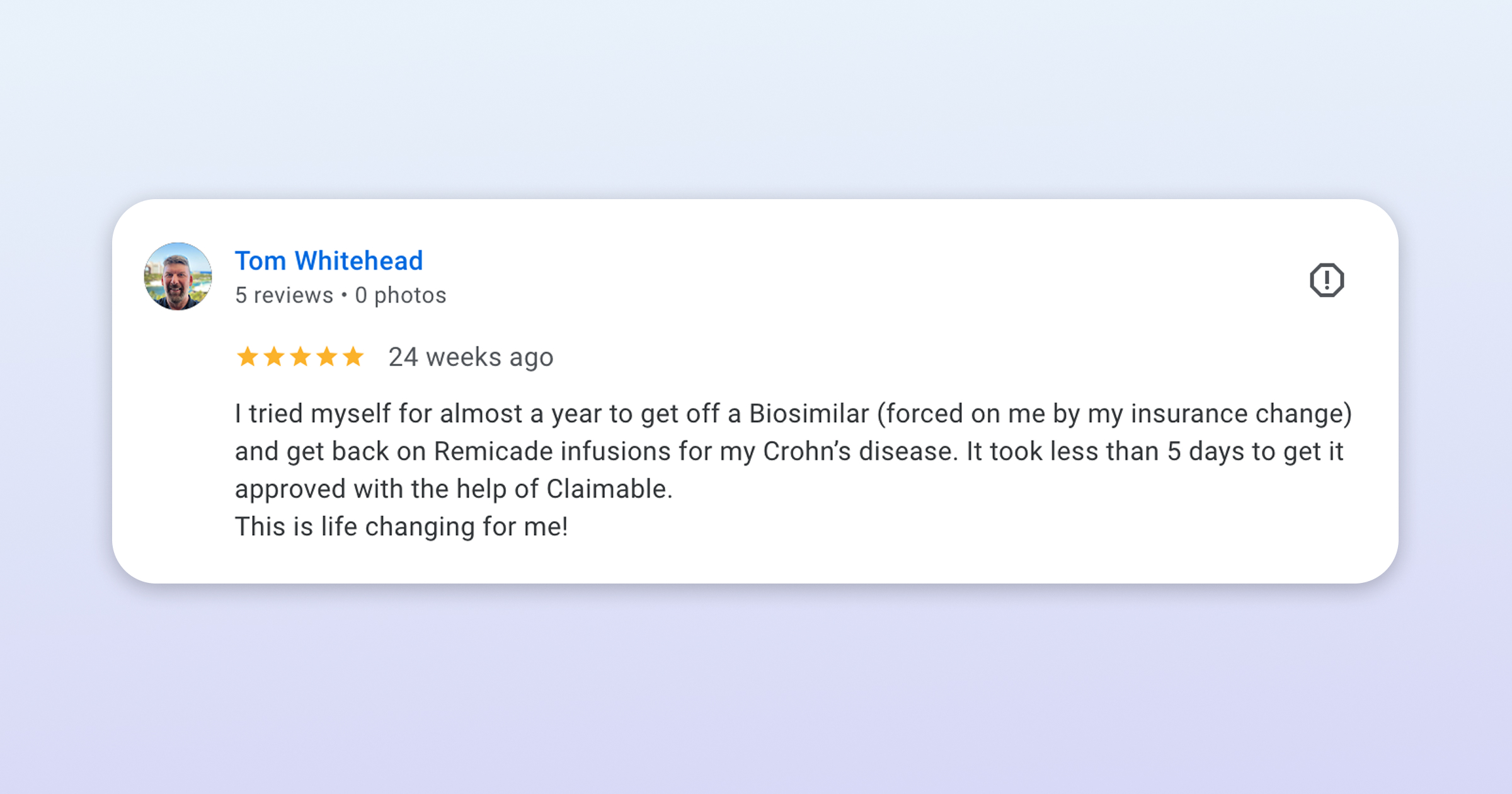
If navigating this process feels overwhelming, Claimable can help. You answer a few questions about your Remicade denial and medical history, and we build a fully customized appeal using our database of millions of clinical studies, insurer policies, and legal standards. The appeal includes your personal narrative, clinical evidence matched to your condition and denial type, and a legal analysis targeting your insurer’s reasoning. We submit directly to your insurer and guide you through escalation if needed.
Thousands of biologic appeals have taught us how each major insurer operates and which arguments win for each Remicade denial type.
Appealing with Claimable costs $39.95. No success fees, no hidden costs. When Remicade can cost $4,000 to $7,000 per infusion without coverage, the math is simple.
Appeal Timelines: How Long Does a Remicade Appeal Take?
Typical timelines for each stage of a Remicade insurance appeal.
The single biggest factor in speed is completeness. Appeals that include everything from the start move faster than submissions that trigger back-and-forth requests for additional information. The average Claimable appeal gets a response in just 10 days.
FAQs
Why was my Remicade denied if my doctor prescribed it?
A prescription and an insurance approval are two different things. Most plans require prior authorization for Remicade, and PA criteria often include step therapy requirements, biosimilar preference mandates, site-of-care restrictions, and documentation thresholds that go well beyond a standard prescription order. Your doctor made a clinical decision. The insurer is applying a separate, more restrictive set of rules.
Can I appeal a Remicade denial myself, or does my doctor have to do it?
You can appeal yourself. Patient-initiated appeals are a separate process from provider appeals, and they carry their own legal protections including mandated response timelines and the right to external review. If your doctor’s prior authorization was denied, your patient appeal is an additional opportunity, not a duplicate.
What if my insurer wants me to switch to a Remicade biosimilar?
It depends on your clinical situation. If you’ve been stable on brand Remicade and have documented reasons why switching poses risk (adverse reactions, disease flares during prior switches, immunogenicity concerns), that’s a strong case for a formulary exception. If you haven’t tried a biosimilar and don’t have a clinical contraindication, trying the preferred biosimilar may be the fastest path to continued treatment.
My insurer denied my dose increase for Remicade. What can I do?
Dose escalation and interval shortening are standard clinical practice for Remicade, especially in IBD, and the 2025 ACG guidelines specifically support dose optimization. Your appeal should include objective evidence of loss of response at the current dose, trough levels and antibody testing if available, and your prescriber’s clinical rationale for the adjustment.
What’s the difference between Remicade and Humira?
Both are TNF inhibitors used for many of the same autoimmune conditions, but they differ in important ways. Remicade (infliximab) is given by IV infusion at a medical facility, typically every 6–8 weeks, and billed under the medical benefit. Humira (adalimumab) is a self-administered subcutaneous injection billed under the pharmacy benefit. That billing distinction means they face different denial types and different appeal pathways.
How much does Remicade cost without insurance?
Remicade typically costs between $4,000 and $7,000 per infusion, depending on your weight, dose, and infusion site. Biosimilars cost less. Johnson & Johnson offers the J&J withMe Savings Program for commercially insured patients, which can reduce costs to as little as $5 per infusion.
Is it worth appealing a Remicade denial?
Almost always, yes. Treatment gaps with Remicade carry real clinical consequences: disease flares, loss of response, and the potential development of antibodies that can make the medication less effective if restarted. Research confirms that IBD patients denied biologic therapy have worse outcomes and more hospitalizations. Fewer than 1% of denials are ever challenged, and insurers have built their entire denial infrastructure around that number. Your doctor prescribed Remicade because you need it. The appeal puts that reasoning in front of someone who has to evaluate it on the merits.
Claimable’s physician-led team has helped patients recover over $30 million in care access by fighting insurance denials. We’re SOC 2 Type II certified and HIPAA compliant. Learn more about how Claimable works →
Be the first to know
Get the latest updates on new tools, inspiring patient stories, expert appeal tips, and more—delivered to your inbox.
You're on the list!