Claimable Blog
Learn about appeals, denials, and stay up to date on what is happening in the world of healthcare.

Your doctor prescribed therapeutic Botox for chronic migraine. Your insurer said no. That denial is the start of a process you have every right to challenge, and this guide covers exactly how to do it.
Botox (onabotulinumtoxinA) is the only botulinum toxin product FDA-approved for the preventive treatment of chronic migraine. The FDA label describes the approved population as adults with chronic migraine: “≥15 days per month with headache lasting 4 hours a day or longer.” Treatment follows the PREEMPT protocol, the clinical trial program that established the standard injection plan: 155 units delivered as 31 injections of 5 units each, across seven head and neck muscle areas, repeated every 12 weeks.
That clinical specificity should make coverage straightforward. But Botox carries a liability no other specialty drug has: it shares a name with the most recognized cosmetic brand in medicine. Insurers exploit that dual identity.
Automated claims systems flag therapeutic Botox as cosmetic. Reviewers who do engage with the medical record apply step therapy requirements — you must try and fail cheaper treatments first — along with documentation thresholds and treatment frequency limits that rank among the most aggressive in specialty medicine.
Each of those barriers can be challenged. Fewer than 1% of denied claims are ever appealed, and insurers count on that. Patients who push back with the right evidence win at dramatically higher rates. We see this daily at Claimable, where our appeals succeed over 80% of the time in established conditions.
Chronic migraine Botox denials fall into a few categories. Either the claim gets auto-flagged as cosmetic before a clinical reviewer ever sees it, the insurer demands more medication failures than the clinical evidence supports, or the prior authorization submission lacks the headache diary or severity documentation the reviewer needs. This guide covers each denial type and how to respond.
Why Insurance Companies Deny Botox for Chronic Migraine
The specific reason on your denial letter determines your entire appeal strategy. It shapes what evidence to gather, which clinical arguments carry weight, and whether a corrected resubmission could resolve the issue before a formal appeal becomes necessary.
How Chronic Migraine Botox Denials Work
Therapeutic Botox is billed under the medical benefit as a physician-administered injection, rather than through the pharmacy benefit. The drug is billed under HCPCS code J0585 — “Injection, onabotulinumtoxinA, 1 unit” — so a 155-unit session appears on the claim as 155 units of J0585, with the injection procedure billed separately. That billing structure means the prior authorization pathway, the documentation requirements, and the appeals process all follow the medical benefit track, which is different from the pharmacy route most other specialty drug denials take.
One diagnostic detail matters more than any other, and most patients never hear it. The FDA label's description of chronic migraine is an indication descriptor, not a diagnostic definition. The formal definition (ICHD-3) is stricter: headache on 15 or more days per month for more than three months, of which at least eight days meet full migraine criteria. Insurers write both requirements into their coverage policies. UnitedHealthcare's botulinum toxin policy, effective April 2026, requires 15 or more headache days per month and eight or more migraine days per month and headaches lasting four or more hours a day. A patient who documents only the 15 headache days gets denied, and never learns why.
There is no generic or biosimilar version of Botox. FDA's biosimilar product list contains no onabotulinumtoxinA entry, so a plan cannot point you toward a cheaper equivalent version of the same drug. Branded competitors exist — Dysport, Xeomin, Daxxify, Myobloc — but they are distinct formulations with different potency units and different approved indications, and none of them carries an FDA-approved indication for chronic migraine prevention.
AbbVie's published wholesale acquisition cost for the 200-unit Botox vial was $1,302 as of its July 2026 price list, with the 100-unit vial at $651. WAC is a manufacturer list price, not what a clinic pays or what you will be billed — but it is a useful anchor when a plan characterizes the treatment as routine or asks you to pay cash.
What We See Across Thousands of Botox Appeals
Denial letters are written to shut the conversation down. These are the most common types, what they mean, and your best first move.
Cosmetic Reclassification
This denial is unique to Botox, and it happens more often than it should. Insurers' claims processing systems sometimes default to a cosmetic classification when they encounter onabotulinumtoxinA, regardless of the diagnosis code attached to the claim. The result is a denial that reads as if you sought wrinkle treatment when your neurologist prescribed migraine prevention.
Why this happens: Botox and Botox Cosmetic are the same active ingredient licensed under the same FDA biologics license, BLA 103000, marketed under different trade names with different approved indications, different NDC codes, and different vial sizes. Therapeutic Botox comes in 100-unit and 200-unit vials; Botox Cosmetic comes in 50-unit and 100-unit vials. The 200-unit vial — the presentation typically used for a 155-unit chronic migraine session — exists only in the therapeutic line. Billing errors, an incorrect NDC, or a missing diagnosis code can route a therapeutic claim into a cosmetic denial workflow. Some plans also maintain blanket exclusions for “botulinum toxin” without distinguishing between cosmetic and medical use.
The argument that wins: Your appeal should establish three things clearly. First, that you are being treated for the FDA-approved indication of chronic migraine. Second, that the prescribing physician is a neurologist or headache specialist treating a documented medical condition. Third, that the dosing, injection sites, and treatment protocol match the FDA-approved treatment plan. A 155-unit, 31-site injection pattern across the head and neck is the chronic migraine protocol. A cosmetic treatment uses a fraction of that dose in entirely different locations. Name the license, the indication, and the product code, and the miscode has nowhere to hide.
Step Therapy and Prior Treatment Required
Most plans require documented failure of, or intolerance to, preventive medications from at least two different classes before they will approve Botox. The usual classes are beta-blockers (propranolol, metoprolol, atenolol, nadolol, timolol), antiepileptics (topiramate, divalproex sodium), and antidepressants — note that this means antidepressants generally, not just tricyclics: venlafaxine, an SNRI, counts on UnitedHealthcare's policy. Some plans additionally require a trial of a CGRP-targeting therapy.
The requirement patients most often miss is duration. UnitedHealthcare's policy requires a trial of at least two months with agents from two of those three classes. A three-week trial that you abandoned because of side effects may not satisfy the criterion on its face, even though intolerance should — which is exactly why documentation matters. Check your own plan's policy document: the number of classes, the named drugs, and the required trial length all vary.
The detail that changes outcomes: “Failure” includes intolerable side effects, contraindications, and clinical reasons a required medication is inappropriate for you. If topiramate causes cognitive impairment that prevents you from working, that counts as failure. If valproate is inappropriate because of pregnancy risk, document that contraindication explicitly. If a beta-blocker is contraindicated because of asthma, that is a documented failure even without a single dose taken.
The argument that wins: In 2024 the American Headache Society issued a position statement update (Charles AC, Digre KB, Goadsby PJ, Robbins MS, Hershey A. Headache. 2024;64(4):333–341) stating that “CGRP-targeting migraine therapies are a first-line option for migraine prevention. Initiation of these therapies should not require trial and failure of non-specific migraine preventive medication approaches.”
Read that scope carefully, because a plan's medical director will. The recommendation covers CGRP-targeting drugs — the monoclonal antibodies and the gepants — and does not extend first-line status to onabotulinumtoxinA, which appears in the statement only among existing chronic migraine preventives. So this statement is a powerful argument against step therapy for a CGRP drug, and a strong signal of where headache medicine is moving. What it does not do, on its own, is make Botox first-line. Use it as evidence that rigid fail-first sequencing has fallen out of step with current practice, and pair it with the PREEMPT data and your own clinical record.
One point of precision worth having right, since insurers blur it: Aimovig (erenumab) and Ajovy (fremanezumab) are both monoclonal antibodies targeting the CGRP pathway, but they work at different points. Erenumab blocks the CGRP receptor; fremanezumab binds CGRP itself so the protein never reaches its receptor. Both differ again from the gepants — Nurtec, Ubrelvy, Qulipta — which are small-molecule pills. If a plan treats these as interchangeable, that imprecision is itself something to challenge.
Not Medically Necessary
This denial typically signals that the prior authorization submission lacked the clinical detail the reviewer needed. For chronic migraine, that usually means a missing headache diary, a missing migraine day count, or insufficient documentation of how prior treatments failed.
A strong resubmission should include the diagnosis with ICD-10 codes, disease severity documented with migraine-specific measures — headache frequency, migraine day frequency, HIT-6 and MIDAS scores — a complete treatment history with dates, doses, trial lengths and specific reasons each prior therapy was stopped, and a detailed clinical rationale for Botox. If the initial PA was thin, a thorough resubmission can often resolve this without a formal appeal.
Frequency Cap Exceeded
The FDA label specifies re-treatment every 12 weeks, which works out to roughly four sessions a year. If your treatment schedule deviates from that interval, or you have reached an annual session cap your plan imposes, the denial reflects a limit on how often the plan will pay — not a disagreement about whether the treatment works.
Your appeal should cite the FDA-approved dosing schedule and document the clinical rationale for your frequency. If your provider is following the labeled interval and the plan's cap is more restrictive than the label, that inconsistency belongs in your appeal.
One related trap worth knowing: the FDA label stops at 155 units across 31 sites. The PREEMPT trials also permitted an optional additional 40 units using a “follow the pain” approach, up to 195 units and 39 sites, but that option is not in the label — and payers cap at 155. If your physician administered more than 155 units, expect that to be the denial reason, and have the clinical rationale ready.
Prior Authorization Not Obtained
If your provider administered the injection before securing prior authorization, the denial is procedural — but do not assume it is fixable. Some plans will review a request after the fact in narrow circumstances: retroactive eligibility, an emergency, or a documented plan or system error. Many now refuse post-service authorization requests outright and simply deny the claim. Where retroactive review does exist, it is usually a provider-side appeal with a short filing window, not a patient entitlement.
The safe sequence is to get authorization in writing before the session. If a session has already happened without it, ask your clinic's billing office to file a post-service review or appeal immediately, check your plan document for the filing deadline, and be prepared to escalate through the formal appeal process and then external review.
Alternative Preferred Product
Some plans prefer Dysport (abobotulinumtoxinA) or Xeomin (incobotulinumtoxinA) for botulinum toxin indications. As of 2026, Botox is the only botulinum toxin product with an FDA-approved indication for chronic migraine prevention — Dysport, Xeomin, Myobloc, Daxxify, Jeuveau and Letybo are approved for other uses only. That is worth saying plainly in an appeal, because plans sometimes cite a “therapeutic alternative” that has no migraine indication at all.
The FDA label is also explicit that potency units are product-specific, and this sentence is worth quoting directly: “The potency Units of BOTOX are specific to the preparation and assay method utilized. They are not interchangeable with other preparations of botulinum toxin products and, therefore, units of biological activity of BOTOX cannot be compared to nor converted into units of any other botulinum toxin products assessed with any other specific assay method.” That language appears in the label's Warnings and Description sections. If a plan proposes a different toxin as a substitute or tries to convert your dose, quote it.
How to Appeal a Botox Chronic Migraine Denial (Step by Step)
Step 0: Confirm the Claim Is Coded Correctly
Before building a formal appeal, rule out an administrative error. Therapeutic Botox denials frequently trace back to incorrect diagnosis codes, a cosmetic procedure code billed instead of a medical one, or a missing J0585 code.
Confirm the claim was submitted with the correct ICD-10 code: G43.709 (chronic migraine without aura, not intractable, without status migrainosus) or G43.711 (chronic migraine without aura, intractable, with status migrainosus). Get both qualifiers right — ICD-10-CM encodes intractability and status migrainosus on separate axes, and a truncated or mismatched code is itself a routine denial reason. Note also that the chronic migraine subcategory (G43.7-) covers chronic migraine without aura only; patients with aura are coded under G43.1- with frequency documented separately. If the claim was miscoded, a corrected resubmission can resolve the denial without a full appeal.
Step 1: Find Your Deadline
Federal law guarantees you at least 180 days from the date you receive your denial notice to file an internal appeal, and plans can give you longer but never less (29 CFR 2560.503-1(h)(3)(i)). On a UnitedHealthcare commercial plan, that 180-day window is exactly what UHC publishes.
Medicare Advantage is different and catches people out. The deadline is 60 calendar days from receiving your notice — but because CMS assumes you received it five days after it was dated, plans publish it as 65 calendar days from the date on the notice. This is the standard CMS deadline for every Medicare Advantage plan, not one insurer's restriction, and it can be extended for good cause (42 CFR 422.582). Your exact deadline is printed on your denial letter. Mark it the day the letter arrives.
Step 2: Use Both Tracks
Your doctor can perform a clinical appeal: resubmitting the PA, writing a letter of medical necessity, and requesting peer-to-peer review — particularly effective for Botox, where a headache specialist speaking directly to the insurer's medical director can overturn a written denial. You file your own patient-initiated appeal on a separate legal track, with guaranteed response timelines and the right to external review. Both tracks work in parallel and strengthen each other.
Step 3: Verify Your Documentation
Confirm ICD-10 codes, headache day counts and migraine day counts, a headache diary spanning at least three months, HIT-6 (Headache Impact Test-6) or MIDAS (Migraine Disability Assessment) scores, and a complete treatment history with dates, doses, trial lengths and reasons each prior therapy was stopped.
Your headache diary is the single most important supporting document. It establishes the 15-or-more headache days per month that the FDA label describes and the eight-or-more migraine days that most insurer policies require. If the insurer denied for cosmetic reclassification, your documentation package needs to make the therapeutic indication unmistakable.
Step 4: Get a Letter of Medical Necessity
Ask your neurologist or headache specialist directly: “I need a letter of medical necessity for my Botox appeal. Can you include my diagnosis with severity documentation, treatment history, the clinical reasons you prescribed onabotulinumtoxinA, and why the alternatives the insurer is requiring are not appropriate?”
The letter should address your specific denial reason, reference the FDA-approved dosing protocol, document your headache and migraine day counts, and detail the preventive medications you have already tried. For any cosmetic reclassification denial, the letter is especially important because it establishes the therapeutic indication directly from the treating physician.
Step 5: Build the Appeal Package
A complete appeal includes a cover letter, the letter of medical necessity, supporting clinical records, and your personal statement. Structure it around three pillars: your story (how chronic migraine affects daily life, and what effective treatment means for your function, work and independence), clinical evidence (PREEMPT trial data, AHS guidance on migraine prevention, and headache specialty society support for your treatment plan), and policy and legal analysis (how your case meets the plan's own written criteria, Affordable Care Act protections, and applicable state laws).
Step 6: Submit and Track
Submit per the denial letter instructions, and keep records of everything.
How fast your plan must answer depends on the claim (29 CFR 2560.503-1(i)). Urgent or expedited appeals: 72 hours. Pre-service appeals, for care you haven't received yet: 30 days. Post-service appeals, for a bill you've already incurred: 60 days. If your plan is cutting off treatment you are already receiving, it must decide before coverage stops and keep covering you in the meantime.
If a treatment gap risks worsening headache frequency, medication overuse, or loss of treatment response, request expedited review.
Step 7: Escalate If Denied Again
After you exhaust internal appeals, you have the right to an independent external review — file within four months of your final internal denial. A standard review is decided within 45 days; an urgent one within 72 hours.
Here is the part most people get wrong, and it matters: if the external reviewer overturns the denial, your plan is required by law to pay, and must do so without delay even if it intends to challenge the decision in court (45 CFR 147.136(c)(2)(xi)). This is not a state-by-state variable. What varies is which process applies, never whether the decision binds.
Additional options include state Department of Insurance complaints, ERISA remedies for employer-sponsored plans, and state step therapy exception laws. One caveat on that last one: state step therapy laws generally do not apply to self-funded employer plans, which cover most people with job-based insurance. Your HR department or plan documents can tell you which kind you have.
An Easier Way: Let Claimable Handle Your Botox Appeal
If the appeal process is more than you can manage, or if you've been denied once and need a stronger approach, Claimable can take it from here.
You answer a few questions about your Botox denial and medical history. We build a fully customized appeal using our database of clinical studies, insurer policies and legal standards — a purpose-built library of real studies, real laws and real policy data, not a general-purpose chatbot guessing at citations. The appeal includes your personal narrative, clinical evidence matched to your migraine history and denial type, and a policy and legal analysis targeting your insurer's reasoning. We submit it directly to your insurer, and we guide you through escalation if it's needed.
Our volume of therapeutic Botox appeals in chronic migraine means we know which plans auto-deny with cosmetic codes, which respond to guideline-based step therapy exceptions, and which escalation paths produce results.
Appealing with Claimable costs $39.95 plus shipping. No success fees, no hidden charges.
Appeal Timelines: How Long Does a Botox Appeal Take?
Complete submissions move faster. Most Claimable appeals are resolved in 10 days or less. Worth planning for the ceiling, though: the regulations allow up to 60 days for a post-service internal appeal and another 45 for external review, so a worst case runs closer to 15 weeks.
FAQs
Why was my therapeutic Botox denied when my doctor prescribed it?
Therapeutic Botox for chronic migraine requires prior authorization from virtually every insurer, and PA criteria typically include step therapy requirements, disease severity thresholds, and specific documentation requirements such as headache diaries and HIT-6 or MIDAS scores. Many denials also stem from the claim being automatically categorized as cosmetic, which can happen before a clinical reviewer ever sees the file. Your doctor made the clinical decision. The insurer is applying its own coverage rules on top.
Can I appeal a Botox denial myself?
Yes. Patient appeals run on a separate legal track from your doctor's clinical appeal, with guaranteed response timelines, the right to external review, and multiple levels of internal appeal. For Botox specifically, requesting a peer-to-peer review between your headache specialist and the insurer's medical director can be especially effective.
My insurer denied Botox and said it's a cosmetic procedure. I'm using it for chronic migraine. What do I do?
This is one of the most common and most correctable Botox denials. The insurer's system likely coded the claim as cosmetic without clinical review. Your appeal should document the therapeutic indication with the correct ICD-10 code, confirm that dosing follows the FDA-approved protocol, and include a letter of medical necessity from your neurologist or headache specialist. The strongest single point: Botox and Botox Cosmetic are licensed under the same FDA biologics license with different indications and different product codes, and the 200-unit vial used for migraine treatment does not exist in the cosmetic line. See the Cosmetic Reclassification section above for the full strategy.
Is there a generic or biosimilar version of Botox?
No. As of 2026 there is no FDA-licensed biosimilar or generic version of Botox — FDA's biosimilar product list does not include onabotulinumtoxinA as a reference product. Branded competitors (Dysport, Xeomin, Daxxify, Myobloc) are clinically distinct products with non-interchangeable potency units, and Botox is the only botulinum toxin product FDA-approved for the preventive treatment of chronic migraine.
How much does therapeutic Botox cost without insurance?
Costs vary widely by setting and by what's counted. The drug alone runs roughly $1,000 to $1,300 per 155-unit session, and the injection procedure adds roughly $150 to $350 on most commercial fee schedules — so a typical allowed amount lands in the $1,200 to $1,600 range. Hospital outpatient departments bill considerably more once a facility fee is added, and billed charges before insurance adjustments frequently reach $2,000 to $3,000 or higher. Ask your clinic for the specific billing codes and their contracted rate rather than relying on a general range.
AbbVie runs the BOTOX Complete Savings Program for patients with commercial insurance. It applies to copay, coinsurance and deductible — up to $1,400 for your first treatment of the year, $1,000 for each subsequent treatment, and $4,000 per calendar year, for up to five treatments in 12 months. It does not apply if you have Medicare, Medicaid or TRICARE, or if you are paying cash. Separately, patients with limited or no insurance coverage who meet income criteria can apply to myAbbVie Assist, AbbVie's patient assistance program, which can provide medicine at no cost. Approval is case by case and requires proof of household income, so confirm current Botox eligibility with the program directly rather than assuming coverage.
My insurer wants me to try Dysport or Xeomin instead of Botox. Are they the same?
No. They are different formulations with different potency units, different approved indications, and different clinical trial profiles. The FDA label for every botulinum toxin product states that units are not interchangeable. Botox is the only botulinum toxin with an FDA-approved indication for chronic migraine, and the PREEMPT clinical trial program that established the standard injection protocol was conducted exclusively with onabotulinumtoxinA. If your physician chose onabotulinumtoxinA for clinical reasons, your appeal should document that rationale and quote the label's non-interchangeability language.
Does the American Headache Society support Botox as first-line for chronic migraine?
Not directly, and it's important to get this right in an appeal. The AHS 2024 position statement update elevated CGRP-targeting therapies — the monoclonal antibodies and gepants — to first-line status, recommending that patients should not have to fail other preventive classes first. That recommendation is scoped to CGRP drugs; Botox appears in the statement only among existing chronic migraine preventives. What the statement does establish is a broad consensus in headache medicine that rigid step therapy delays effective treatment. OnabotulinumtoxinA remains a well-established, FDA-approved preventive with strong clinical trial support in the PREEMPT program. If your insurer demands multiple oral medication failures before approving Botox and your clinical record supports earlier intervention, that gap between insurer policy and clinical practice strengthens your appeal.
Is it worth appealing a Botox denial?
In most cases, yes. Chronic migraine affects patients on 15 or more days every month, and untreated chronic migraine carries real clinical consequences: escalating headache frequency, medication overuse, lost work days, and deteriorating quality of life. The appeals process exists for situations where an administrative or formulary decision diverges from your clinical reality. Your doctor prescribed Botox because the evidence supports it. The appeal forces the insurer to respond to that evidence on the record.
Claimable's physician-led team has helped patients recover over $30 million in care access by fighting insurance denials. We're SOC 2 Type II certified and HIPAA compliant. Learn more about how Claimable works →
Insurer coverage policy details in this guide were verified in August 2026. Plan criteria are typically revised at least annually — check your own plan's current policy document before filing.

Taltz (ixekizumab) is FDA-approved for four conditions across dermatology and rheumatology, and it has beaten two of its main competitors in head-to-head clinical trials. It's also one of the specialty medications our appeals team sees denied most often — largely because another drug in the same IL-17A class reached insurers' covered drug lists first.
That drug is Cosentyx, approved in January 2015, fourteen months before Taltz. Most insurers treat the two as interchangeable, listing Cosentyx as the preferred option and requiring patients to try it before they'll consider Taltz. The clinical reality is more nuanced. These are distinct molecules with different dosing schedules, different head-to-head profiles, and documented cases of patients responding to one after the other didn't work well enough. Your appeal letter needs to make that distinction clearly, or it gets filed in the denial pile.
This guide walks through a proven appeal letter structure section by section, explains how to customize each part for your specific Taltz denial, and covers what to do if the first response comes back unfavorable.
If you'd prefer not to build an appeal from scratch, Claimable generates fully customized Taltz appeals backed by a purpose-built database of clinical studies, insurer policies and legal standards, then submits them directly to your insurer on your behalf.
Start Here: Identify Your Denial Type
Before writing anything, find the exact denial reason on your letter. The entire strategy changes depending on which barrier you're facing.
Taltz treats four distinct conditions — moderate-to-severe plaque psoriasis in adults and children aged 6 and older, active psoriatic arthritis, active ankylosing spondylitis, and active non-radiographic axial spondyloarthritis with objective signs of inflammation — and each carries its own step therapy requirements and supporting clinical evidence. A psoriasis appeal built around PASI scores (a measure of psoriasis severity) won't help if the denial is for psoriatic arthritis and the insurer's objection is about joint disease documentation.
If the denial traces back to a correctable issue — a missing TB screening, an outdated severity assessment, or a wrong diagnosis code — you may not need a formal appeal at all. A resubmission with the missing documentation can sometimes resolve it faster.
Taltz Appeal Letter: What to Include, Plus a Customizable Template
We've created a free, customizable appeal letter template you can use as a starting point for your Taltz appeal:
Download the free appeal letter template →
Each section of a strong Taltz appeal serves a specific function. Here's what to include and why.
Section 1: Identifying Information, Claim Details, and Denial Reference
Start with a header block that identifies you, your insurer's appeals department, and the specific claim at issue. The opening paragraph should name the medication, the prescribing physician, your diagnosis, and the insurer's stated denial reason, quoted directly from the letter. Reproducing their exact language matters. Everything that follows is a targeted response to that specific rationale.
If a gap in treatment poses a medical risk — disease progression, worsening joint damage, or your body losing its response to the medication — this is also where you request an expedited review. Plans must decide expedited appeals within 72 hours.
Note your appeal deadline immediately. Federal law guarantees you at least 180 days from the date you receive your denial notice to file an internal appeal, and plans can give you longer but never less. Medicare and Medicaid run on their own schedules — Medicare Advantage, for example, generally gives you 60 days from when you receive the notice (often published as 65 days from the notice date to allow for mailing). Your exact deadline is printed on your denial letter. Mark your calendar the day it arrives and file as early as you can.
Section 2: Your Diagnosis and Its Impact on Your Life
This section establishes your clinical profile and makes the human cost of the denial concrete. Include your diagnosis with ICD-10 codes if available, any other conditions you have, and a specific description of how your condition affects daily life.
For Taltz, the indication your prescriber documented shapes the entire appeal strategy.
For plaque psoriasis, document disease severity using PASI scores, body surface area involvement, and plaque location. Face, palms, scalp and genital psoriasis carry extra weight because they directly affect daily life. For psoriatic arthritis, center the appeal on tender and swollen joint counts, functional limitations, and the risk of irreversible joint damage. For ankylosing spondylitis or non-radiographic axial spondyloarthritis, document BASDAI scores (a disease activity questionnaire), morning stiffness duration, imaging findings, and the impact on mobility. A reviewer who sees concrete severity data reads the clinical sections differently than one who sees vague references.
Section 3: Prior Treatments and Their Outcomes
This section demonstrates that you've already done what the plan requires, or that there's a documented clinical reason those requirements don't apply to you. Present prior treatments in a clear table.
Specific dates, drug names and documented outcomes are what turn a general claim into evidence the insurer is required to address.
Two details that frequently get overlooked. First, “failure” encompasses intolerable side effects, medical reasons you can't safely take the drug, and results that didn't reach a meaningful level of improvement, in addition to complete non-response. Second, if you're currently on Taltz and responding well, the continuity of care argument — that switching would reverse clinical progress and risk flare or loss of response — belongs here as well.
Section 4: Why Taltz Is Medically Necessary
This section connects your physician's clinical judgment, your treatment history, and how your condition is trending into a single argument. It should explain why Taltz specifically, as distinct from the broader IL-17 inhibitor class, is the appropriate medication, and what happens without it.
Medical necessity is the standard most denials ultimately turn on. Explain what happens without Taltz: disease progression, irreversible joint damage, or compounding loss of function depending on your diagnosis. If your prescriber has written a letter of medical necessity, this section reinforces that clinical reasoning with your own perspective.
One detail for patients already on Taltz that's easy to miss: use your baseline disease severity from before starting treatment, not your current scores. Insurers have denied coverage based on improved numbers, penalizing patients for responding to the medication. Your pre-treatment clinical picture is what establishes the need.
Section 5: Clinical Evidence Supporting Taltz
This section does the heaviest lifting, and it’s where most generic appeal letters miss. Cite specific clinical trials, match each to your indication, and connect the data to the insurer’s stated reason for denial.
Match the trial evidence to your indication. Taltz has been studied across all four of its approved conditions, and the trials that support a plaque psoriasis claim are not the ones that support a psoriatic arthritis or axial spondyloarthritis claim. Citing a skin study for a joint-disease denial misses the point. Use the trials that fit your diagnosis, and take the response rates and any comparator data straight from the published trial rather than from memory or a summary.
If your denial is specifically a “try Cosentyx first” denial, head-to-head evidence is your most important tool — and precision matters more than enthusiasm, because a plan’s medical director will check the details. State each result exactly as the trial reported it, including the later timepoints where two drugs may converge. An appeal that overstates a result gives the reviewer a reason to distrust everything else in the letter; one that states the data precisely and then explains why your clinical profile favors Taltz is much harder to dismiss.
Document why, given your clinical profile, the insurer’s preferred agent is not the right choice: a documented inadequate response to Cosentyx, a specific dosing consideration, or head-to-head data relevant to your disease characteristics.
A serious caution: never cite a study you haven’t verified. General-purpose AI tools routinely generate fabricated clinical references. A single invented citation gives the reviewer a clean justification to dismiss your entire appeal.
Section 6: The Denial Doesn't Align With Your Insurer's Own Criteria
Insurers publish their Taltz coverage policies, and those documents are publicly available. Pull the relevant policy, identify each criterion, and show point by point that you meet them.
The effect is that the insurer has to address its own written rules. If the policy requires documented failure of a conventional systemic and your records show six months on methotrexate with liver toxicity, show the match. If it requires TNF inhibitor failure and you've tried and failed two, list them against the criteria.
For patients denied because the plan prefers Cosentyx, this section is where you demonstrate that you've already met the plan's requirements for trying preferred alternatives, or that clinical factors make the preferred agent inappropriate for your case.
Section 7: Applicable State and Federal Law
Legal citations move your appeal from a request to a demand. The specific protections available depend on your plan type and your state, but they often include the Affordable Care Act's guaranteed rights to internal appeal and independent external review, state step therapy override laws, and ERISA protections for employer-sponsored plans.
Most states have now passed some form of step therapy protection — trackers maintained by patient advocacy groups put the count in the high 20s to high 30s depending on how strictly “reform” is defined. Where such a law applies, it typically lets patients bypass a required step when they've already tried and failed comparable drugs or when the required step would cause irreversible harm.
One critical limit: state step therapy laws generally do not apply to self-funded employer plans, which cover most people with job-based insurance. Check whether your coverage is fully insured or self-funded before building an argument on a state protection.
Section 8: Request for Review and Approval
Close with a formal, specific request. Ask the insurer to approve coverage for Taltz, override the cited denial barrier, and if the situation is time-sensitive, process the appeal on an expedited basis. Ask for written confirmation of the decision. If the appeal is denied, request the complete claim file so you can see every document the reviewer considered and identify any gaps for the next level of review.
Section 9: Supporting Documentation
List everything you're including: the physician's letter of medical necessity, medical records documenting your diagnosis and treatment history, relevant lab results including TB screening, disease severity assessments, the clinical studies cited in the letter, the original denial letter, and any prior appeal decisions. Nothing should require the reviewer to go searching.
Section 10: Citations and References
End with a full reference list of every clinical trial, guideline, insurer policy and statute cited. This doubles as your own quality check. If you can't produce a clean, verifiable citation for a claim, that claim should not be in the letter.
An Alternative Approach: Use Claimable
The template above provides the architecture of a strong appeal. But the sections that determine whether it succeeds — clinical evidence, policy analysis, legal citations — are also the ones that require hours of targeted research and where errors weaken your case.
Claimable does this work for you. You answer a few questions about your Taltz denial and medical history. We build a fully customized appeal using our database of clinical studies, insurer policies and legal standards — real studies, real laws and real policy data, not a general-purpose chatbot guessing at citations. The appeal includes your personal narrative, clinical evidence matched to your condition and denial type, and a policy and legal analysis targeting your insurer's reasoning. We submit it directly to your insurer, and we guide you through escalation if it's needed.
Over 80% of Claimable appeals succeed in established conditions, with most resolved in 10 days or less. Appealing costs $39.95 plus shipping — no success fees, no hidden charges.
Start your Taltz appeal with Claimable →
Common Mistakes That Get Taltz Appeals Denied
Treating the Preferred Cosentyx Denial as a Simple Swap Request
When a plan prefers Cosentyx and you're appealing for Taltz, the instinct is to argue that both drugs are essentially the same. That approach backfires. If they're the same, the insurer has no reason to approve the non-preferred one. Your appeal needs to document why Taltz is clinically distinct for your situation, supported by head-to-head data and your individual treatment history.
Ignoring the IBD Warning When It's Relevant
Taltz carries a Warning and Precaution — not a boxed warning — for inflammatory bowel disease. If you also have IBD or a history of it, your appeal needs to address this proactively. If your prescriber chose Taltz because your IBD is inactive and clinically monitored, document that reasoning.
Get the incidence right, because it varies by condition and a blanket “under 1%” is wrong for some patients. In adult psoriasis trials, Crohn's disease occurred in 0.1% of Taltz patients and ulcerative colitis in 0.2%. In pediatric psoriasis, Crohn's was 0.9%. In ankylosing spondylitis trials the rates were 1.0% and 0.5% — so if you're appealing for AS or non-radiographic axial spondyloarthritis, use the AS figures. Your prescriber should monitor for new or worsening symptoms, and Taltz should be stopped if IBD develops.
Submitting the Same Evidence for Different Indications
A psoriasis appeal built on PASI scores won't move a reviewer evaluating a psoriatic arthritis denial. Match your evidence to your diagnosis. If you have overlapping conditions such as psoriasis and PsA, document both and cite the SPIRIT-H2H combined skin-and-joint endpoint — while being accurate that the advantage over Humira came primarily from the skin component.
Citing Fabricated Studies or Incorrect Legal References
General-purpose AI tools generate convincing-looking clinical citations that don't exist. A reviewer who catches one fabricated source has every reason to treat the entire submission as unreliable. Verify every reference before it goes near your insurer. Claimable runs on a purpose-built database of real, verified sources for exactly this reason.
Missing the Filing Deadline
Deadlines are printed on your denial letter and they are absolute. Federal law gives you at least 180 days from receiving your denial for a commercial plan internal appeal; Medicare Advantage runs on 65 calendar days from the notice date. Missing the window eliminates your right to appeal entirely. Mark the deadline the day the letter arrives.
Don't Navigate This Alone If You Don't Have To
You have the legal right to appeal, the clinical evidence to support it, and a process designed to give you multiple chances to make your case.
After you exhaust internal appeals, you have the right to an independent external review — file within four months of your final internal denial. A standard review is decided within 45 days; an urgent one within 72 hours. And if the reviewer overturns the denial, your plan is required by law to pay, and must do so without delay even if it intends to challenge the decision in court.
If you'd rather not spend hours verifying clinical studies and tracking down insurer policies, Claimable handles the research-intensive work and submits on your behalf.
Download the free appeal letter template → or start your Taltz appeal with Claimable →
FAQs
Why was my Taltz denied when my doctor prescribed it?
Taltz requires prior authorization from virtually every insurer. PA criteria typically require you to try other drugs first (like a TNF inhibitor or Cosentyx), show that your disease is severe enough, and fill your prescription through a specialty pharmacy. Your doctor made the clinical decision. The insurer is applying its own utilization rules on top.
Can I appeal a Taltz denial myself?
Yes. Patient appeals run on a separate legal track from your doctor's clinical appeal, with guaranteed response timelines, the right to external review, and multiple levels of internal appeal. Your appeal and your doctor's work on parallel tracks and strengthen each other.
My insurer wants me to try Cosentyx instead of Taltz. Are they interchangeable?
No. Although both are IL-17A inhibitors, Taltz and Cosentyx are distinct medications with different molecular structures, different dosing schedules, and different clinical trial profiles. Patients who don't respond well enough to one IL-17A inhibitor may respond to the other. If your insurer is treating them as interchangeable, your appeal should document the clinical rationale for Taltz specifically.
Is there a generic or biosimilar version of Taltz?
No. There is no FDA-approved biosimilar or generic version of Taltz in the United States — FDA's biosimilar product list contains no ixekizumab entry. Taltz was licensed in March 2016, which gives it 12 years of reference-product exclusivity through March 2028, with additional patent protection beyond that. By contrast, Stelara now has several approved biosimilars, which is often exactly why a plan will push you toward it. Taltz is dispensed through specialty pharmacies rather than retail pharmacies; more than 150 specialty pharmacies can fill it.
How much does Taltz cost without insurance?
Taltz's list price is $7,261.51 per 80 mg autoinjector or prefilled syringe. Because the loading dose is two injections and maintenance is one injection every four weeks, annual list-price cost runs roughly $94,000 at steady state, and about $109,000 to $131,000 in the first year depending on the indication — psoriasis costs more in year one because of the twice-monthly induction phase. List price is not what most insured patients pay, but it is the number that drives your plan's prior-authorization and tier decisions.
Eli Lilly's Taltz Savings Card can bring your cost down to $5 per month if you have commercial insurance that covers Taltz, or $25 per month if your commercial plan doesn't cover it — up to 3 pens per 28-day supply, with a maximum benefit of $10,600 per calendar year. You are not eligible if you have any government coverage: Medicare, Medicaid, TRICARE, VA, DoD, or a state pharmaceutical assistance program. Separately, the Lilly Cares Foundation may provide Taltz at no cost if your household income is at or below 500% of the federal poverty level (about $79,800 for an individual or $165,000 for a family of four in 2026) and you are not enrolled in Medicaid, the full low-income subsidy, or VA benefits.
What's the difference between Taltz dosing for psoriasis vs. psoriatic arthritis or AS?
For adult plaque psoriasis, Taltz starts with 160 mg at week 0 — given as two 80 mg injections, which surprises a lot of patients — then 80 mg every two weeks through week 12, then 80 mg every four weeks. For psoriatic arthritis and ankylosing spondylitis, it's 160 mg at week 0, then 80 mg every four weeks. For non-radiographic axial spondyloarthritis, there's no loading dose: 80 mg every four weeks from the start. Patients with psoriatic arthritis and coexistent moderate-to-severe plaque psoriasis follow the psoriasis schedule. Pediatric psoriasis dosing is weight-based.
Is it worth appealing a Taltz denial?
Almost always. Taltz is typically prescribed when the clinical picture calls for an IL-17A inhibitor, and for many patients that means other treatments have already been tried or are contraindicated. Untreated psoriatic disease causes irreversible joint damage, and treatment gaps with biologics risk flares and loss of response. In ankylosing spondylitis specifically, long-standing inflammation can cause new bone to form between vertebrae, and in some people the spine's joints eventually fuse — the change doctors see on X-ray as “bamboo spine.” That develops over years and does not happen to everyone; severe disability is relatively uncommon. In non-radiographic axial spondyloarthritis there is no visible joint damage on X-ray by definition, and only some patients go on to develop the radiographic form. Controlling inflammation early is one reason treatment matters.
The appeals process exists for situations where a formulary decision doesn't reflect your clinical reality. Your doctor prescribed Taltz because the evidence supports it. The appeal forces the insurer to respond to that evidence on the record.
Claimable's physician-led team has helped patients recover over $30 million in care access by fighting insurance denials. We're SOC 2 Type II certified and HIPAA compliant. Learn more about how Claimable works →
Insurer coverage policy details in this guide were verified in August 2026. Plan criteria are typically revised at least annually — check your own plan's current policy document before filing.
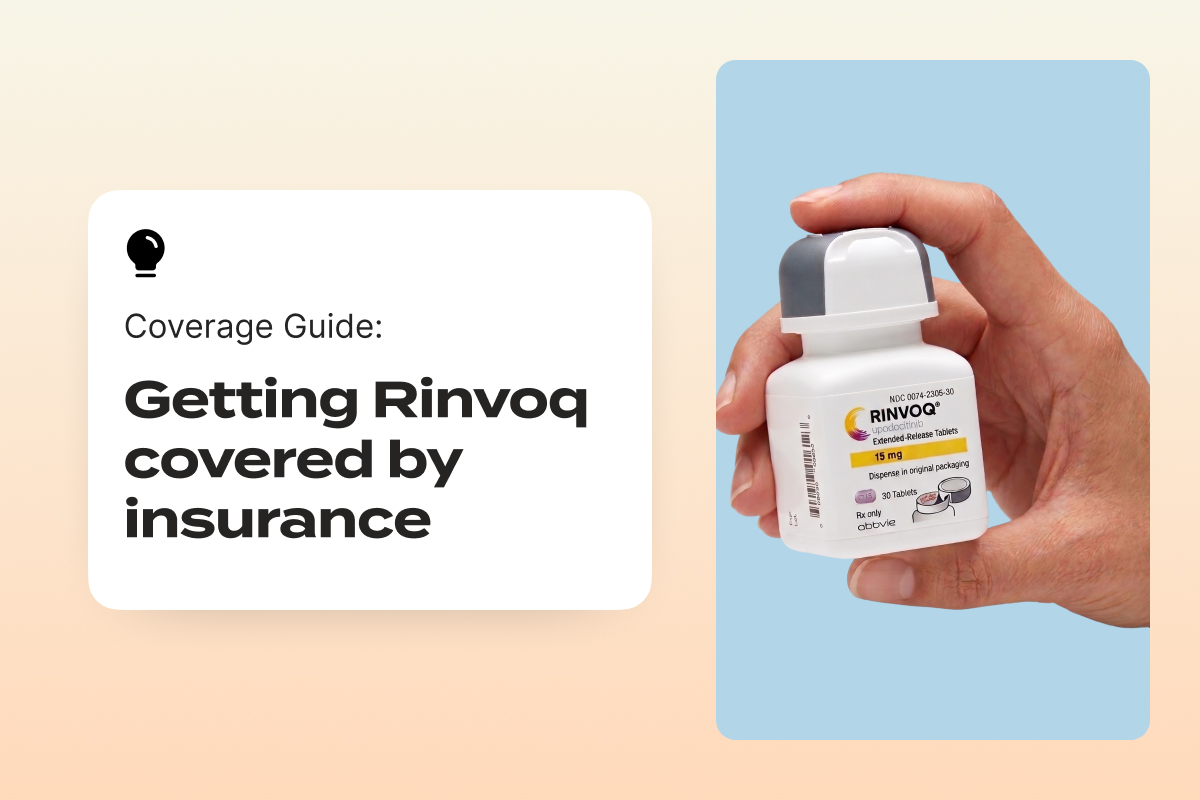
Your doctor prescribed Rinvoq because it’s the right treatment for your condition. Your insurer denied it. And the reason likely traces back to a safety study of a different drug, in a different patient population.
Rinvoq (upadacitinib) is a JAK1 inhibitor, a pill that targets a specific enzyme driving inflammation in autoimmune disease. It’s FDA-approved for nine conditions across rheumatology, dermatology, and gastroenterology. The AAD, ACR, ACG, and AGA all include it in their treatment recommendations.
Insurers still treat it like a last resort. Every JAK inhibitor used for autoimmune and inflammatory conditions carries a boxed warning for serious infections, heart problems, cancer, and blood clots, based primarily on a trial called ORAL Surveillance that studied Xeljanz (tofacitinib) – not Rinvoq – in rheumatoid arthritis patients 50 and older with preexisting heart disease risk factors. The FDA applied that warning across all JAK inhibitors, to ensure awareness of potential risks. Insurers took it as a green light to make Rinvoq one of the hardest specialty medications to get approved.
However, denials can be overturned. Fewer than 1% of denied claims are ever appealed, and insurers count on that. Patients who push back with specific evidence see dramatically higher success rates. We see this daily at Claimable, where our appeals succeed over 80% of the time in established conditions.
Rinvoq denials look different depending on your diagnosis, your dose, and the specific barrier your insurer raised. An RA patient denied because they haven’t tried a TNF blocker (a type of biologic that targets a specific inflammatory protein) is in a different situation than an atopic dermatitis patient whose insurer won’t approve the 30 mg dose. This guide covers each denial type and how to respond.
Why Insurance Companies Deny Rinvoq Coverage
The reason on your denial letter shapes every part of your response. It determines what evidence to gather, which arguments to lead with, and whether a corrected resubmission might resolve the issue before you need a formal appeal.
How Rinvoq Denials Differ
Rinvoq treats nine conditions across three medical specialties, but its denial patterns share a common thread: the boxed warning. Unlike biologics such as Skyrizi or Stelara, which face restrictions driven primarily by cost and competition from biosimilars (cheaper near-copies of brand-name drugs), Rinvoq faces an additional barrier rooted in a class-wide safety label that many clinicians consider overly broad.
Dosing adds complexity. For rheumatology conditions, the dose is 15 mg once daily. Atopic dermatitis may require 15 mg or 30 mg. Ulcerative colitis starts with a 45 mg daily induction dose for 8 weeks, while Crohn’s disease starts with 45 mg daily for 12 weeks; both then transition to 15 mg or 30 mg for maintenance. Insurers that approve the 15 mg dose may deny the higher doses that clinical circumstances demand.
There is no generic version of Rinvoq. AbbVie holds patent protection through at least 2037. At over $7,000 per month without insurance, nearly every major insurer aggressively restricts who can get it.
What We See Across Thousands of Appeals
Denial letters are written to shut the conversation down. These are the most common types, what they mean, and your best first move:
Step Therapy and TNF Failure Required
Most insurers require documented failure on at least one TNF blocker before they’ll approve Rinvoq. This requirement is baked into the FDA labeling itself for most of Rinvoq’s uses, giving insurers regulatory backing. Some plans go further, requiring failure on two or more biologics or conventional therapies.
The specifics vary by diagnosis. RA and PsA patients typically need conventional DMARD failure plus at least one TNF blocker. AS/nr-axSpA requires NSAIDs plus TNF blocker failure. Atopic dermatitis requires topical therapies and may require systemic immunosuppressant or biologic failure before a JAK inhibitor is considered. For UC and Crohn’s, conventional therapies and TNF blocker failure are standard requirements, though the updated FDA indication (October 2025) now allows use when TNF blockers are not a safe option for the patient, as long as they’ve tried at least one approved systemic therapy. Giant cell arteritis (approved April 2025) is so new that many plans are still developing criteria.
The detail that changes outcomes: “failure” includes side effects, contraindications, and documented clinical reasons a drug is inappropriate. If a TNF blocker carries risks your doctor has identified (history of demyelinating disease, heart failure, recurrent infections), that counts as failure even if you never took a single dose.
The argument that wins: For RA, the SELECT-SWITCH study showed that patients did better switching to Rinvoq than cycling to another TNF blocker. The ACR guidelines support JAK inhibitors after inadequate response to conventional DMARDs. For UC, the 2025 ACG guidelines give upadacitinib a strong recommendation with high-quality evidence. For atopic dermatitis, the AAD guidelines recommend upadacitinib for moderate-to-severe disease. Citing these guidelines challenges the insurer to explain why their step therapy requirements exceed what clinical evidence supports.
Boxed Warning / Safety-Based Restriction
This denial is unique to JAK inhibitors. Some insurers impose additional screening requirements, age-based restrictions, or outright denials citing the class-wide boxed warning for serious infections, cancer, heart problems, and blood clots.
Why this matters: The ORAL Surveillance study tested a different drug (Xeljanz) in a specific high-risk population (RA patients aged 50+ with heart disease risk factors). The FDA extended the findings to all JAK inhibitors based on shared mechanism. Upadacitinib’s own clinical trial data has not shown the same safety problems, and many clinicians and published safety analyses have questioned whether the class-wide application was warranted. Insurers use the warning to justify restrictions that go beyond what the FDA requires.
The argument that wins: Address the safety concern head-on. If you’re under 50, have no heart disease risk factors, and no history of cancer, those facts should be front and center. Document that your physician has evaluated the risks and benefits specific to your case. Show that the benefits outweigh the risks for your situation — your physician has already made that determination, and the appeal puts it on the record.
Not Medically Necessary
This denial usually means the PA submission was incomplete. A strong resubmission should include your diagnosis with ICD-10 codes, disease severity documented with objective measures appropriate to your condition (DAS28 for RA, EASI/IGA for atopic dermatitis, partial Mayo for UC, CDAI for Crohn’s), complete treatment history with dates and reasons each therapy was stopped, and clinical rationale for upadacitinib. A thorough resubmission often resolves this without a formal appeal.
Formulary Exclusion
If your plan doesn’t cover Rinvoq at all, a formulary exception with medical necessity documentation is your primary path forward. Document why the formulary alternatives are not appropriate for your specific situation. Plans that cover tofacitinib (Xeljanz) but not Rinvoq should be challenged on the clinical differences: upadacitinib’s more selective JAK1 inhibition, broader range of approved indications, and comparative real-world data.
Dose Denial (30 mg or 45 mg)
Some insurers approve 15 mg but refuse the higher doses. For UC, the 45 mg induction dose is the FDA-approved starting point for the indication. For Crohn’s disease, the same applies: 45 mg daily for 12 weeks is the labeled induction regimen. Denying the induction dose means denying the treatment.
The argument that wins: Cite the FDA-approved dosing for the specific indication. For AD dose escalation, document objective severity scores showing inadequate response at 15 mg. For UC, the 45 mg daily induction for 8 weeks is the labeled regimen. For Crohn’s, it is 45 mg daily for 12 weeks. Both are FDA-approved starting protocols for their respective indications.
Specialty Pharmacy Restriction
Rinvoq is dispensed through specialty pharmacies. If your plan requires a specific one and you tried to fill elsewhere, the fix is typically straightforward: identify the plan’s designated specialty pharmacy and have your prescriber route the prescription there.
How to Appeal a Rinvoq Denial (Step by Step)
Step 1: Find Your Deadline
Most commercial plans allow 180 days. Medicare Advantage plans follow CMS timelines with a 60-day window from receipt of the denial notice (plans often state this as 65 calendar days from the notice date). Your exact deadline is printed on your denial letter. Missing the deadline eliminates your rights.
Step 2: Use Both Tracks
Your doctor handles the clinical appeal (resubmitting the PA, writing a letter of medical necessity, requesting peer-to-peer review). You file your own patient-initiated appeal on a separate legal track with guaranteed response timelines and the right to external review. Patient appeals and your doctor’s clinical appeal work on parallel tracks. Filing your own gives you additional leverage, additional levels of review, and an independent external review that is binding on your insurer. Use both.
Step 3: Verify Your Documentation
Confirm ICD-10 codes, disease severity scores appropriate to your condition, and treatment history with dates, doses, and reasons each prior therapy was stopped. For safety-based denials, include documentation of heart disease risk assessment and baseline labs.
Step 4: Get a Letter of Medical Necessity
This is an important document in your appeal. It should cover your diagnosis with severity scores, complete treatment history, clinical rationale for upadacitinib, and a direct response to the insurer’s stated denial reason.
Ask your doctor directly: “I need a letter of medical necessity for my Rinvoq appeal. Can you include my diagnosis, severity scores, treatment history, and the clinical reasons you chose upadacitinib over the alternatives the insurer is requiring?”
Step 5: Build the Appeal Package
A complete appeal includes the cover letter, the LMN, supporting clinical records, and your personal statement. Structure it around the three pillars: your story (how your condition affects daily life), clinical evidence (relevant specialty guidelines plus head-to-head trial data), and policy and legal analysis (how your case meets the plan’s own criteria, ACA protections, applicable state step therapy laws).
Step 6: Submit and Track
Submit per the denial letter instructions. Insurers must respond within 30 days (standard) or 72 hours (urgent). Keep records of everything.
Step 7: Escalate If Denied Again
You have the right to external review by an independent third party. Their decisions are binding on your insurer. Additional options include state Department of Insurance complaints, ERISA remedies, and state step therapy exception laws.
An Easier Way: Let Claimable Handle Your Rinvoq Appeal
If the appeal process is more than you can manage, or if you’ve been denied and need a stronger approach, Claimable can take it from here.
Here’s how it works:
- You answer a few questions about your Rinvoq denial and medical history.
- We build a fully customized appeal using our database of millions of clinical studies, insurer policies, and legal standards.
- The appeal includes your personal narrative, clinical evidence matched to your condition and denial type, and a policy and legal analysis targeting your insurer’s reasoning.
- We submit it directly to your insurer.
- We guide you through escalation if it’s needed.
Appealing with Claimable costs $39.95 plus shipping for Rinvoq. No success fees, no hidden costs. When Rinvoq runs over $7,000 per month and untreated autoimmune disease can progress to permanent joint damage or surgical complications, the cost of not appealing is far higher.
Appeal Timelines: How Long Does a Rinvoq Appeal Take?
Complete submissions move faster. For example, in most cases, Claimable appeals get a response in just 10 days.
FAQs
Why was my Rinvoq denied when my doctor prescribed it?
Rinvoq requires prior authorization from virtually every insurer, and PA criteria typically include step therapy mandates, disease severity thresholds, safety screening tied to the JAK inhibitor boxed warning, and specialty pharmacy routing. Your doctor made the clinical decision. The insurer is applying its own utilization rules on top.
Can I appeal a Rinvoq denial myself?
Yes. Patient appeals run on a separate legal track from your doctor’s clinical appeal, with guaranteed response timelines, the right to external review, and up to two levels of internal appeal depending on your plan. Your appeal and your doctor’s appeal work on parallel tracks and strengthen each other.
Why does Rinvoq have a boxed warning if it’s safe enough for the FDA to approve?
The boxed warning was applied to all JAK inhibitors after the ORAL Surveillance study found higher rates of heart problems and cancer with Xeljanz (a different JAK inhibitor) in older RA patients with heart disease risk factors. The FDA extended this warning to upadacitinib based on shared mechanism, even though upadacitinib’s own clinical program has not shown the same problems. The FDA still determined that Rinvoq’s benefits outweigh its risks across all nine approved indications.
Is there a generic version of Rinvoq?
No. AbbVie holds patent protection through at least 2037 based on settlement agreements with generic manufacturers. No generic entry is expected before then.
My insurer wants me to try Humira first. Is Rinvoq actually better?
In the SELECT-SWITCH trial studying RA patients who had already failed a TNF blocker, those who switched to Rinvoq achieved low disease activity by week 12 at nearly double the rate of those who switched to Humira: 43.3% versus 22.4%. In atopic dermatitis, the Heads Up head-to-head trial showed Rinvoq 30 mg cleared skin and reduced itch better than Dupixent. Whether Rinvoq is right for your situation depends on your clinical picture, but the data support switching mechanisms rather than cycling through another TNF blocker after failure.
How much does Rinvoq cost without insurance?
A 30-day supply of Rinvoq 15 mg tablets has a list price over $7,000 without insurance. The manufacturer’s list price (WAC) is $7,090.41 as of January 2026, though retail prices vary by pharmacy. Annualized, that exceeds $80,000. AbbVie offers the RINVOQ Complete Savings Card, which may reduce the out-of-pocket cost to as little as $0 per month for eligible commercially insured patients. AbbVie also maintains a bridge program that provides Rinvoq at no charge for up to two years (or until coverage is approved, whichever comes first) for commercially insured patients aged 63 and younger whose coverage is denied, provided an appeal is submitted every 180 days.
What’s the difference between Rinvoq dosing for RA vs. IBD vs. atopic dermatitis?
For rheumatology conditions (RA, PsA, AS, nr-axSpA, GCA), the dose is 15 mg once daily. For atopic dermatitis, the starting dose is 15 mg with escalation to 30 mg available based on clinical response. For UC, treatment starts with 45 mg daily for 8 weeks (induction), then transitions to 15 mg or 30 mg for maintenance. For Crohn’s disease, treatment starts with 45 mg daily for 12 weeks (induction), then transitions to 15 mg or 30 mg for maintenance. This dosing variation is a common source of denials when insurers fail to recognize that the prescribed dose matches the FDA-labeled regimen for the patient’s condition.
Is it worth appealing a Rinvoq denial?
Almost always. Rinvoq is typically prescribed after other options have been tried or ruled out. Untreated RA leads to progressive joint destruction. Uncontrolled atopic dermatitis degrades quality of life through constant itch and skin breakdown. IBD progresses to strictures, fistulas, and surgical complications. The appeals process exists for situations where a formulary restriction doesn’t reflect clinical reality. Your doctor prescribed Rinvoq because the evidence supports it. The appeal forces the insurer to respond to that evidence on the record.
Claimable’s physician-led team has helped patients recover over $60 million in care access by fighting insurance denials. We’re SOC 2 Type II certified and HIPAA compliant. Learn more about how Claimable works →

Zach Veigulis, co-founder and Chief AI Officer of Claimable, recently joined Vivian Tu — the former Wall Street trader millions know as Your Rich BFF — on her podcast Networth & Chill.
Vivian built her platform on the idea that money advice should be for everyone, in plain language. She reached out because a denied insurance claim is one of the most common financial shocks an American family can face, and most people have no idea how to fight back. The conversation covered a lot of ground. Here are the moments worth carrying with you.
The system is working exactly as designed
Health insurance began during the Great Depression as a billing arrangement: Baylor Hospital in Texas let Dallas teachers pay 50 cents a month for hospital care so the hospital could keep its doors open. Nearly a century later, roughly 5 billion claims are submitted each year across commercial and government insurance. Nearly 1 billion get denied and fewer than 1% of those denials are ever appealed. As Zach put it on the show, the insurer is betting you’ll walk away. The math keeps working in their favor for exactly as long as patients stay quiet.
A denial letter is an opening offer, not the last word
The letter is written to look final. It reads like a closed door. But patients who appeal win far more often than they lose — at Claimable, more than 80% of our appeals succeed. Zach walked Vivian’s audience through how to push back, and the steps are more straightforward than most people expect.
Start by reading your denial letter closely. Insurers are legally required to send one, and it has to spell out the reason for the denial, your appeal rights, and your deadline. Find that deadline immediately, because it drives everything that follows. Most commercial plans give you 180 days, though some windows are shorter. From there, file your internal appeal — and if your situation is urgent, request an expedited review, which can force a 72-hour response instead of the standard 30 days. If the internal appeal fails, request an external independent review. That reviewer doesn’t work for your insurer, which is a large part of why external reviews overturn denials more often than people realize.
The words that change the outcome
Zach also shared the specific language that gets an appeal evaluated correctly. If your drug isn’t on the formulary, ask for a “formulary exception.” If you’re being moved off a medication that’s already working for you, ask for a “continuity of care exception” so there’s no gap in coverage while your appeal is decided. The biggest mistake he sees is the generic appeal letter. Every denial gives a reason, and that reason tells you exactly which argument will beat it — a formulary exclusion demands a different response than a “not medically necessary” ruling, and treating them the same is how winnable appeals get lost.
What this looks like for a real patient
Zach told the story of a woman in her 50s, a stay-at-home parent who survived Stage IV melanoma and then developed severe inflammatory arthritis as a result of her cancer treatment. She couldn’t climb stairs or grip a steering wheel, and four board-certified specialists recommended the same drug to treat it. Her insurer denied it three times over nine months. Claimable prepared a 23-page appeal citing her doctors, the clinical guidelines, and the inconsistencies in the insurer’s own written policies, with copies sent to federal and state regulators. The denial was reversed in 48 hours — after nine months of fighting, it was over in two days, and the insurer issued a formal apology.
Where Claimable comes in
Most people don’t know they can appeal, and many who do don’t know how to do it correctly. Claimable exists for exactly those situations, where access to care can be genuinely life-or-death. Patients upload their denial letter, answer questions about their health story, and Claimable generates a customized appeal backed by clinical evidence and policy analysis. The whole process takes under 30 minutes, at a flat $39.95 per appeal with no success fee.
Our thanks to Vivian and the Networth & Chill team for making room for this conversation. The more people who know their rights, the faster that giving-up math stops working.
Watch the full episode on YouTube here.
Frequently asked questions
How long do I have to appeal an insurance denial?
Most commercial plans allow 180 days from the date of your denial for an internal appeal, but some windows are shorter, so check your denial letter for the exact deadline. Urgent situations may qualify for an expedited review with a much faster response.
What is an external independent review?
If your internal appeal is denied, you can request a review by an independent third party who doesn’t work for your insurer. Because the reviewer is independent, external reviews overturn denials at meaningful rates.
What’s a continuity of care exception?
It’s a request to keep you on a medication that’s already working while your appeal is decided, protecting you from a gap in coverage during a non-medical switch.
Do I have a better chance appealing myself?
Patients often have stronger legal protections and more review levels available than they realize, and appeal success rates rise sharply when the appeal is built around the specific reason for the denial and backed by clinical and policy evidence.
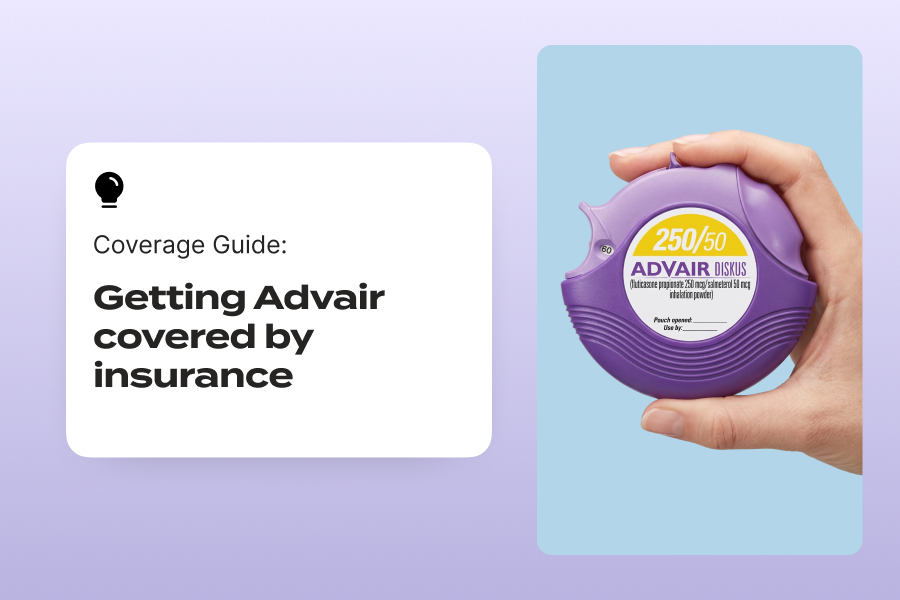
Your doctor prescribed Advair because your asthma or COPD requires a combination of an inhaled corticosteroid to reduce airway inflammation and a long-acting bronchodilator to keep your airways open, working together in every dose. Then your insurer said no.
You have the right to challenge that denial, and many patients who do succeed. Advair has been one of the most widely prescribed respiratory medications in the world for over two decades. Millions of patients with asthma and COPD rely on it, and your doctor prescribed it for a reason. When an insurer denies Advair, the dispute is almost always over which specific form, device, or brand of combination inhaler you should be using.
The specifics of which Advair you were prescribed can determine the entire denial. Advair comes in two devices, the Diskus (a dry powder inhaler) and the HFA (a metered dose inhaler). Generic versions of the Diskus have been available since 2019, including Wixela Inhub and authorized generic fluticasone/salmeterol.
An authorized generic of Advair HFA exists, but it is inconsistently stocked, and many plans still treat it as if no generic option exists. Most plans require the generic Diskus form whenever possible, but patients who need the HFA specifically face tighter coverage restrictions for a device-specific need.
Other patients face a different version of this problem. Their plan prefers a different ICS/LABA entirely, such as Breo Ellipta or Symbicort, and requires a trial of the preferred drug before covering Advair. Still others are denied because the prior authorization submission was too thin, or because the plan requires stepping through an ICS-only inhaler first.
Fewer than 1% of denied claims ever get appealed because of how confusing and intimidating the process feels. However, patients who do push back with the right evidence see dramatically better results. We see this every day at Claimable, where our appeals succeed more than 80% of the time in established conditions. This guide walks through each Advair denial type and how to respond.
Why Insurance Companies Deny Advair Coverage
The denial reason on your letter determines your strategy. A patient denied because the plan requires generic fluticasone/salmeterol is in a completely different situation than one denied because the insurer prefers Breo Ellipta. Match your denial to the corresponding response before you do anything else.
What Makes Advair Denials Different
Advair denials center on cost optimization: which form, which device, and which brand the insurer prefers.
The Diskus vs. HFA split is the coverage issue most specific to Advair. The Diskus is a dry powder inhaler (DPI) that relies on the strength of your breath to pull the powder into your lungs. The HFA is a metered dose inhaler (MDI) that sprays medication out automatically, regardless of how strongly you can inhale.
For most adults with adequate lung function, either device works. But for patients who can’t use a DPI effectively, the HFA may be their only option, and because generic HFA availability is inconsistent, they face tighter coverage restrictions.
Generic fluticasone/salmeterol is widely available and covered by most plans with lower copays than brand Advair. For patients who can use the Diskus form, switching to Wixela Inhub or authorized generic fluticasone/salmeterol usually works just as well.
What We See Across Thousands of Appeals
Here are the most common denial types, what they actually mean, and where to start:
Brand Denied, Generic Required
This is the most common Advair denial. Your plan covers fluticasone/salmeterol but requires the generic version (Wixela Inhub or authorized generic) rather than brand Advair Diskus.
When to switch: generic fluticasone/salmeterol contains the same active ingredients at the same doses and meets FDA bioequivalence standards. For most patients using the Diskus form, the generic is clinically equivalent and costs significantly less (as low as $50-$55 with a discount card vs. $200+ for brand).
When to appeal: if you’ve had a documented adverse reaction to a generic formulation, if you have difficulty using the Wixela Inhub device (which resembles the Diskus but differs slightly in design), or if your prescriber has a specific clinical reason for requiring brand. In most cases, though, switching to generic is the fastest path to coverage.
HFA Denied, Diskus or Generic Required
This is the denial most specific to Advair. Your plan covers the dry powder form (Diskus or generic) but won’t cover Advair HFA, the metered dose inhaler. Because generic HFA availability is inconsistent, most plans still restrict HFA coverage as the higher-cost option.
The argument that wins: some patients cannot use a dry powder inhaler effectively. Dry powder devices require a minimum breathing force to deliver medication properly, and your doctor can measure whether you meet that threshold. Patients who can’t meet that threshold, including young children, elderly patients with reduced lung capacity, individuals with severe COPD or acute exacerbations, and patients with neuromuscular conditions, may need the HFA because it sprays medication automatically rather than relying on the strength of your breath. If the patient can also benefit from a spacer device (which only works with MDIs, not DPIs), that’s an additional clinical reason.
Your prescriber should document the specific clinical reason the HFA form is medically necessary, including breathing test results, device technique assessments, or clinical conditions that make the dry powder form ineffective for you.
Different ICS/LABA Preferred
Some plans prefer a different ICS/LABA combination over fluticasone/salmeterol. Common preferred alternatives include Breo Ellipta (fluticasone furoate/vilanterol, once-daily dosing), Symbicort or generic budesonide/formoterol, and AirDuo (fluticasone/salmeterol in a different device).
When the switch makes sense: if you don’t have a specific clinical reason to be on fluticasone/salmeterol and haven’t tried the preferred alternative, switching may be straightforward. All ICS/LABA inhalers reduce asthma symptoms and exacerbations.
When to appeal: if you’ve already tried and failed the preferred alternative (intolerable side effects, inadequate symptom control, device issues), if you’re stable on Advair and switching introduces unnecessary risk, or if there’s a specific clinical reason fluticasone/salmeterol is the better combination for you. Document the prior trial, the outcome, and the prescriber’s rationale.
Step Therapy Required
Some plans require a trial of an ICS-only inhaler (fluticasone, budesonide, beclomethasone) before they’ll approve the addition of a LABA. This is more common for patients with a new asthma diagnosis or those stepping up therapy.
The detail that matters: if your asthma severity warrants combination therapy from the start (moderate persistent or worse, with a history of exacerbations on an ICS alone), your doctor’s appeal should cite the current treatment guidelines — specifically GINA 2026 and the NHLBI Expert Panel Report guidelines and its 2020 Focused Update — both of which support ICS/LABA for patients with persistent asthma not adequately controlled on ICS alone. If you’ve already tried an ICS-only inhaler and it wasn’t sufficient, document that trial with dates, doses, and symptom outcomes.
Not Medically Necessary
This denial usually means the PA was submitted with insufficient clinical documentation. A strong resubmission includes the following: your diagnosis with the standardized codes your insurer needs to process the claim (called ICD-10 codes), breathing test results, exacerbation history (ER visits, hospitalizations, oral steroid courses), current symptom burden, and a complete medication history showing prior therapies tried.
How to Appeal an Advair Denial (Step by Step)
Step 0: Confirm the Prescription Is Coded Correctly
Before launching a full appeal, rule out an administrative error. A surprising number of Advair denials trace back to a wrong diagnosis code, the claim being sent to the wrong part of your plan (for example, processed as a medical claim instead of a pharmacy claim, or vice versa), or a mismatch between the prescribed form and what was submitted on the prior authorization.
Ask your prescriber’s office to confirm the diagnosis codes, the exact product identifier (called an NDC) submitted, and whether the claim was routed to the correct benefit. Catching a coding error here can resolve the denial without any appeal at all.
Step 1: Find Your Deadline
Most commercial plans allow 180 days. UnitedHealthcare limits many plans to 65 calendar days. Medicare Advantage plans allow 60 days. Missing the deadline eliminates your rights.
Step 2: Use Both Tracks
This is one of the most underused strategies in the appeals process. Your doctor handles the clinical appeal (resubmitting the PA, writing a letter of medical necessity, requesting peer-to-peer review). But you also have your own, separate appeal rights as a patient — a legal track with guaranteed response timelines, the right to external review by an independent third party, and multiple levels of appeal.
Patient-initiated appeals complement provider appeals. They run on parallel tracks, and using both puts maximum pressure on the insurer to evaluate your case on the merits. Here’s why appealing yourself, not just leaving it to your doctor, matters.
Step 3: Verify Your Documentation
Confirm your diagnosis codes, severity classification, breathing test results, exacerbation history, and prior medication trials. For HFA-specific appeals, include documentation of why the dry powder form isn’t appropriate (your doctor can provide breathing force measurements and device technique assessments).
Step 4: Get a Letter of Medical Necessity
This is an important document in your appeal. It should include your diagnosis with severity scores, treatment history, and clinical rationale addressing the insurer’s specific denial reason. For HFA appeals, the rationale should explicitly address why the DPI form is inadequate. For preferred alternative denials, document why the plan’s preferred ICS/LABA doesn’t fit your situation.
Here is a plain-language way to ask your doctor: “My insurance denied Advair. I’d like to appeal, and one of the strongest pieces of evidence is a letter of medical necessity from you. It should explain my diagnosis, what we’ve already tried, and why this specific form of Advair is the right treatment for me. Can your office put that together so I can include it in my appeal?”
Step 5: Build the Appeal Package
A complete appeal includes the cover letter, letter of medical necessity, supporting clinical records (breathing tests, exacerbation history, medication history), and your personal statement.
Structure it around three pillars: your story (how uncontrolled asthma or COPD affects your daily life), clinical evidence (your doctor can reference GINA 2026 and NHLBI guidelines supporting your treatment), and policy and legal analysis (how your case meets the plan’s criteria, Affordable Care Act protections, applicable state laws).
Step 6: Submit and Track
Submit per the denial letter instructions. Insurers must respond within 30 days (standard) or 72 hours (urgent). Keep records of everything — dates, names of representatives, confirmation numbers, and copies of every document you send. If a deadline passes and you haven’t heard back about your appeal, you have options to hold the insurer accountable.
Step 7: Escalate If Denied Again
You have the right to external review by an independent third party. Their decisions are binding in most states. Additional options include state Department of Insurance complaints, remedies under ERISA, the federal law governing employer-sponsored plans, and state laws that limit when insurers can force you to switch medications or require you to try cheaper drugs first.
Appeal Timelines: How Long Does an Advair Appeal Take?
Complete submissions move faster. The average Claimable appeal gets a response in just 10 days.
FAQs
Why was my Advair denied if it’s been around for 25 years?
Coverage decisions are based on formulary placement and cost, regardless of how long a drug has been available. Most plans now require generic fluticasone/salmeterol rather than brand Advair, and some prefer a different ICS/LABA altogether. Advair HFA faces the steepest coverage barriers because generic HFA availability is inconsistent. Your plan likely covers some form of ICS/LABA combination, just not the specific form your doctor prescribed.
Is generic fluticasone/salmeterol the same as Advair Diskus?
Yes, in terms of active ingredients and FDA bioequivalence. Wixela Inhub and authorized generic fluticasone/salmeterol contain the same medications at the same strengths as Advair Diskus. The devices differ slightly in design but function similarly. For most patients, the switch is straightforward.
My plan denied Advair HFA. Can I use the Diskus instead?
It depends on why your doctor prescribed the HFA. If you can breathe in forcefully enough for a dry powder inhaler and are comfortable with the technique, the Diskus or Wixela Inhub may work just as well. If you need the metered dose inhaler because of reduced breathing strength, difficulty with DPI technique, or the need for a spacer, your appeal should document that clinical need specifically.
My insurer wants me to use Breo Ellipta instead. Is that the same?
Both are ICS/LABA combination inhalers, though they differ in important ways. Breo Ellipta uses fluticasone furoate/vilanterol and is dosed once daily. Advair uses fluticasone propionate/salmeterol and is dosed twice daily. Some patients do well on either; others respond better to one combination. If you’ve already tried the preferred alternative and it didn’t work, or if your doctor has a specific reason for choosing fluticasone/salmeterol, document that in your appeal.
Can I appeal an Advair denial myself, or does my doctor have to do it?
You can, and you should. Your doctor files a clinical appeal through the insurer’s provider process, but you have your own, independent appeal rights as a patient. Patient-initiated appeals run on a separate legal track with guaranteed timelines, external review rights, and multiple levels of appeal. Using both tracks gives you the best chance of overturning the denial.
How much does Advair cost without insurance?
Brand Advair Diskus and HFA run roughly $200-$500 per inhaler at retail. Generic fluticasone/salmeterol (Wixela Inhub) can cost as little as $50-$55 with a discount card. GSK offers a copay card that caps out-of-pocket costs at $35 per month for eligible commercially insured patients — this card is not valid for Medicare, Medicaid, or other government-funded plans. The Viatris savings card for Wixela Inhub can reduce insured patient copays to as little as $10 per fill. For patients without commercial insurance, GSK’s patient assistance program may provide the medication at no cost to eligible patients who meet income requirements.
Is it worth appealing an Advair denial?
Yes, particularly if the denial is blocking access to the specific formulation or device your doctor determined you need. Poorly controlled asthma leads to ER visits, hospitalizations, missed work and school, and progressive decline in lung function. COPD exacerbations can be life-threatening. The stakes of an asthma denial can be devastating. If the insurer’s preferred alternative isn’t clinically appropriate for your situation, the appeal puts your doctor’s reasoning in front of someone who has to evaluate it on the merits.
Claimable’s physician-led team has helped patients recover over $30 million in care access by fighting insurance denials. We’re SOC 2 Type II certified and HIPAA compliant. Learn more about how Claimable works →
Your doctor prescribed Symbicort because your asthma or COPD needs a specific type of treatment, but your insurer denied it. The reason probably has less to do with whether you need an ICS/LABA inhaler (a combination of an inhaled steroid and a long-acting airway opener) than with the fact that your plan's formulary (its preferred drug list) ranks cheaper alternatives ahead of it.
Symbicort (budesonide/formoterol) is the only widely available ICS/LABA that can serve as both your daily controller and your rescue inhaler in a single device. It contains formoterol, an airway opener that works fast enough to also serve as a rescue medication. That fast action is what makes SMART therapy (Single Maintenance and Reliever Therapy) possible. The GINA (Global Initiative for Asthma) 2025 guidelines recommend SMART as the preferred approach for moderate-to-severe asthma. Advair and Breo Ellipta, the alternatives most drug lists prefer, contain airway openers that work more slowly and cannot double as rescue inhalers.
That hasn't stopped insurers from building their drug lists around those alternatives. Most plans prefer generic fluticasone/salmeterol or Breo over Symbicort. Most exclude the brand and only cover the generic version. And plans that do cover it often set a limit on how many inhalers you can get per month, which are frequently too few for SMART therapy patients. The result is that a treatment the guidelines recommend keeps getting blocked by drug lists that weren't designed to support it.
However, denials can be overturned. Fewer than 1% of denied claims are ever appealed, and insurers count on that. But patients who push back with specific evidence see dramatically higher success rates. At Claimable, our appeals succeed over 80% of the time in established conditions.
Symbicort denials look different depending on your diagnosis, your treatment plan, and the specific barrier your insurer put up. A patient denied because the plan caps how many inhalers it will cover each month is in a different situation than one denied because their plan prefers a different inhaler. This guide covers each type and how to respond.
Why Insurance Companies Deny Coverage for Symbicort
The specific denial reason determines your strategy. A patient denied because the plan prefers a different ICS/LABA is in a different situation than one denied because they hit a quantity limit, or one whose plan excluded brand Symbicort in favor of the generic.
What We See Across Thousands of Appeals
These are the most common denial types, what they actually mean, and where to start:
Plan Prefers a Different Inhaler
This is the most common Symbicort denial. Your plan prefers a different ICS/LABA, typically generic fluticasone/salmeterol (generic Advair), Breo Ellipta, or Wixela Inhub, and won't cover Symbicort until you've tried the preferred option.
When the switch makes sense: if your doctor prescribed Symbicort for standard twice-daily maintenance and doesn't plan to use it for SMART therapy, and you don't have a clinical reason to need formoterol specifically, the preferred alternative may work just as well for controlling your asthma or COPD. ICS/LABA inhalers in general are effective at reducing symptoms and exacerbations.
When to appeal: if your doctor prescribed Symbicort specifically for SMART therapy, the preferred alternatives simply cannot fill that role. Advair and Breo contain salmeterol or vilanterol, neither of which work fast enough to be used as a rescue inhaler. Requiring a trial of those alternatives first asks you to fail a medication that cannot perform the function your doctor prescribed Symbicort for. Your appeal should cite the GINA 2025 guidelines, which recommend ICS-formoterol as the preferred treatment approach, and explain the plan's preferred alternatives cannot substitute for Symbicort in SMART therapy. When the block is a straight formulary exclusion rather than a step requirement, a formulary exception request is often the fastest route to coverage.
Other clinical reasons to appeal include: documented intolerance or side effects with the preferred alternative, better symptom control on Symbicort than on the preferred option (if you've already tried it), or a specific clinical feature like exercise-triggered symptoms where formoterol's fast action matters.
Brand Not Covered, Generic Only
Most plans now exclude brand Symbicort and cover only generic budesonide/formoterol or Breyna. This is one of the more straightforward denials.
When to switch: generic budesonide/formoterol contains the same active ingredients at the same doses and meets the same FDA standards proving it works the same way in your body. For most patients, switching to the generic is clinically equivalent and often cheaper.
When to appeal: if you've had a documented adverse reaction to a generic formulation (differences in inactive ingredients or propellant can occasionally cause issues), or if the generic isn't available at your pharmacy. In most cases, though, the generic is usually the simplest option.
Quantity Limit Exceeded
This denial is specific to SMART therapy patients. Standard Symbicort dosing is 2 puffs twice daily (4 puffs per day, 120 puffs per inhaler, roughly a 30-day supply). SMART therapy adds as-needed rescue puffs on top of that maintenance dose, which means patients may need more than one inhaler per month. Most plans set quantity limits at one inhaler per 30 days.
The argument that wins: SMART therapy is the GINA-recommended approach for moderate-to-severe asthma. The additional puffs replace a separate rescue inhaler (typically albuterol), which reduces total medication use and exacerbations over time. Your prescriber should submit a quantity override request with documentation of your asthma severity, the SMART therapy protocol, and the clinical evidence showing that SMART reduces severe exacerbations by roughly 60–65% compared with using only a short-acting rescue inhaler.
Step Therapy Required
Some plans require a trial of a different ICS/LABA before they'll cover Symbicort. This overlaps with the "preferred alternative" denial but is more rigid. Instead of just preferring the alternative, the plan won't approve Symbicort at all until you've tried the required drug and shown it didn't work.
The detail that matters: if the step therapy drug cannot serve the clinical purpose your doctor intended (SMART therapy), requiring you to try it first doesn't make clinical sense. Your appeal should state that the required step therapy drug and budesonide/formoterol are not interchangeable for your prescribed use. Cite the GINA 2025 guidelines and the NHLBI (National Heart, Lung, and Blood Institute) 2020 asthma management guidelines, both of which support SMART therapy with ICS-formoterol specifically. Many states also have step therapy exception protections that require insurers to grant an exception when the required drug is expected to be ineffective for your situation.
Not Medically Necessary
This denial typically means the prior authorization submission didn't include enough clinical detail. A strong resubmission includes your diagnosis with ICD-10 codes (the standard diagnostic codes doctors use) — for example, your asthma severity classification or COPD staging — along with measurable data showing how severe your condition is: spirometry results (a breathing test that measures lung function), exacerbation history, symptom frequency, and current controller medications.
It should also include a clear clinical reason why budesonide/formoterol is the appropriate treatment. For asthma, include your current step level per GINA or NHLBI guidelines. For COPD, include your GOLD classification (the international standard for rating COPD severity) and exacerbation history.
How to Appeal a Symbicort Denial (Step by Step)
Step 0: Verify Your Coding and Benefit Routing
Before you start a formal appeal, confirm that the denial is actually a clinical or formulary decision and not a billing error. Many Symbicort denials trace back to incorrect ICD-10 coding (for example, unspecified asthma instead of moderate persistent asthma), a wrong NDC (the drug's product identification number) or quantity field, or the claim being routed to the wrong benefit (for example, pharmacy instead of medical, or vice versa).
Ask your prescriber's office to verify the diagnosis codes and your pharmacy to confirm the NDC submitted. If the denial letter references a coding or administrative reason, fixing and resubmitting the claim may resolve it without a full appeal.
Step 1: Find Your Deadline
Most commercial plans allow 180 days. UnitedHealthcare limits many plans to 65 calendar days. Medicare Advantage plans allow 60 calendar days. If you miss these windows, you may lose your right to appeal, so mark the deadline as soon as the denial arrives.
Step 2: Use Both Tracks
Your doctor handles the clinical appeal — resubmitting the prior authorization, writing a letter of medical necessity, and requesting a peer-to-peer review (a call where your doctor speaks directly with the insurer's doctor). You file your own patient-initiated appeal on a separate legal track with guaranteed response timelines and the right to external review. These tracks complement each other, and using both gives you the strongest position.
Step 3: Verify Your Documentation
Confirm your diagnosis codes, your disease severity measures (spirometry, exacerbation count, symptom frequency), and treatment history. For SMART therapy appeals specifically, confirm that your prescriber has documented the SMART protocol and the clinical reason for using budesonide/formoterol as both maintenance and rescue.
Step 4: Get a Letter of Medical Necessity
This is an important document in your appeal. It should include your diagnosis with severity classification, treatment history (including any prior ICS/LABA trials and outcomes), and the clinical reason for choosing Symbicort, directly addressing the insurer's denial reason. For SMART therapy appeals, the letter should explain why a formoterol-containing inhaler is clinically necessary and why the plan's preferred alternatives cannot serve the same role.
Ask your doctor directly: "I need a letter of medical necessity for my Symbicort appeal. It should address why I specifically need budesonide/formoterol and why the plan's preferred alternatives won't work for my treatment plan."
Step 5: Build the Appeal Package
A complete appeal includes the cover letter, letter of medical necessity, supporting clinical records (spirometry results, exacerbation history, medication history), and your personal statement. Structure it around three parts: your story (how poorly controlled asthma or COPD affects your daily life, work, sleep, and physical activity), clinical evidence (GINA 2025, NHLBI 2020 guidelines, SMART therapy evidence), and policy and legal analysis (how your case meets the plan's criteria, ACA (Affordable Care Act) protections, and any applicable state laws that let you skip required drug trials when they don't apply to your situation).
Step 6: Submit and Track
Submit per the denial letter instructions. Insurers must respond within 30 days (standard) or 72 hours (urgent). For asthma patients with frequent exacerbations or recent ER visits, an expedited appeal may be appropriate. Keep records of everything.
Step 7: Escalate If Denied Again
You have the right to external review by an independent third party. Their decisions are binding in most states. Additional options include state Department of Insurance complaints, ERISA protections (federal rules that govern employer-sponsored health plans), and state step therapy exception laws.
Appeal Timelines: How Long Does a Symbicort Appeal Take?
Complete submissions move faster. The average Claimable appeal gets a response in just 10 days.
FAQs
Why was my Symbicort denied when my doctor prescribed it?
Most Symbicort denials are driven by which ICS/LABA your plan prefers, not whether you need one at all. Many drug lists favor generic fluticasone/salmeterol (generic Advair) or Breo Ellipta over budesonide/formoterol, and most now exclude brand Symbicort in favor of the generic version. Your doctor chose budesonide/formoterol for a clinical reason. The insurer is applying its own drug-list preferences on top of that.
Can I appeal a Symbicort denial myself?
Yes. Patient appeals run on a separate legal track from your doctor's clinical appeal, with guaranteed response timelines, the right to external review, and multiple levels of internal appeal. Filing your own appeal complements your doctor's efforts and gives you access to protections and escalation options that the provider track alone does not offer.
Is generic budesonide/formoterol the same as Symbicort?
Yes, in terms of active ingredients, dosing, and FDA standards proving the generic works the same way in your body. Generic budesonide/formoterol (including Breyna) contains the same medications at the same strengths. For most patients, the switch is clinically equivalent. If your plan requires the generic and you don't have a documented reason to stay on brand, switching is usually the fastest path to coverage.
My plan wants me to use Advair or Breo instead. Are they the same?
They're all ICS/LABA combination inhalers, but they're not interchangeable for every use. Advair contains fluticasone/salmeterol. Breo Ellipta contains fluticasone/vilanterol. Neither contains formoterol, which means neither can be used for SMART therapy (using the same inhaler for both maintenance and rescue). If your doctor prescribed Symbicort specifically for SMART, the plan's preferred alternatives cannot serve that clinical purpose.
What is SMART therapy, and why does it affect my coverage?
SMART (Single Maintenance and Reliever Therapy) uses a budesonide/formoterol inhaler for both daily maintenance and as-needed rescue instead of carrying a separate albuterol inhaler. The GINA 2025 guidelines recommend it as the preferred approach for asthma because clinical evidence shows it reduces severe exacerbations by roughly 60–65% compared with using only a short-acting rescue inhaler. SMART affects coverage because it requires more puffs per month than standard maintenance dosing, which can trigger quantity limit denials. It also requires a formoterol-containing inhaler, which conflicts with plans that prefer non-formoterol ICS/LABAs.
How much does Symbicort cost without insurance?
Brand Symbicort runs $350–$500 per inhaler without insurance. Generic budesonide/formoterol costs $150–$300 at retail, or as low as $90–$150 with a discount card. AstraZeneca offers a savings card for brand Symbicort that can cap the cost at $35 per 30-day supply for eligible commercially insured patients. Viatris offers a savings card for Breyna that can reduce the cost to as little as $20 per month for eligible commercially insured patients. For uninsured or underinsured patients who qualify, AstraZeneca's AZ&Me program may provide the medication at no cost.
Is it worth appealing a Symbicort denial?
Yes, especially if the denial is blocking access to SMART therapy or forcing you onto an inhaler that your doctor has already determined isn't appropriate for your situation. Poorly controlled asthma leads to ER visits, hospitalizations, missed work, and gradual loss of lung function. COPD exacerbations carry even more serious consequences. Getting the inhaler your doctor prescribed can mean the difference between controlled disease and a trip to the emergency room. The Schmidtknecht family's story is a stark reminder of what's at stake when asthma medication is delayed. If your doctor prescribed budesonide/formoterol for a clinical reason, an appeal puts that reasoning in front of someone who has to evaluate it.
Claimable's physician-led team has helped patients recover over $30 million in care access by fighting insurance denials. We're SOC 2 Type II certified and HIPAA compliant. Learn more about how Claimable works →
Let's get you covered.