Claimable Blog
Learn about appeals, denials, and stay up to date on what is happening in the world of healthcare.
Mounjaro is the only dual GIP/GLP-1 available for type 2 diabetes, and your doctor prescribed it for a reason. When your insurer sends back a denial, it can feel like the end of the conversation. It isn’t.
Most commercial insurance plans and Medicare Part D formularies cover Mounjaro for type 2 diabetes, but “covered” doesn’t always mean to it's accessible. Prior authorization requirements, step therapy that tries to push you onto older medications first, and formulary restrictions (usually driven by rebate deals rather than clinical data) all create barriers between you and the prescription your doctor wrote. And if Mounjaro was prescribed off-label for weight loss, coverage can be an uphill battle. Because it's so complicated, many patients give up on treatment entirely after a denial rather than navigate the appeals process.
Less than 1% of denied claims get appealed, so the insurance industry assumes you’ll just accept their decision. That assumption saves insurers billions every year. But the low appeal rate says more about how opaque the process is than how unlikely you are to win. Patients who do push back with solid evidence see dramatically higher overturn rates. At Claimable, our appeals succeed over 80% of the time in established conditions.
The type of denial you received matters a lot in terms of how to write your appeal. A formulary restriction is different from a step therapy requirement, and this guide walks you through how to respond to each.
Why Insurance Companies Deny Mounjaro Coverage
Before building your appeal, find the specific reason that your insurance denied coverage. Understanding your denial type means that you can fight it with the correct arguments.
What We See Across Thousands of GLP-1 Appeals
Denial letters use insurer language that's designed to sound final, even though most denials are anything but. Here’s how to decode the most common denial types for Mounjaro, what they actually say about your situation, and where to begin:
Off-Label Use Denials: The Weight Loss Problem
Mounjaro is FDA-approved only for type 2 diabetes. It isn't approved for weight loss, while Zepbound is – even though both contain tirzepatide. If Mounjaro is prescribed to a patient for weight loss, most insurers will deny coverage. That denial is hard to overturn because it’s technically correct.
Your options: If you have type 2 diabetes, the problem may be a coding issue rather than a real coverage dispute (see Step 0 below). If you don’t have diabetes and are seeking tirzepatide for weight management, consider asking your doctor about Zepbound, the version of tirzepatide that carries an FDA-approved weight management indication. If your prescriber believes off-label Mounjaro is clinically appropriate for a specific comorbidity, some plans will consider a formulary exception with a strong letter of medical necessity (though this is a harder fight).
Step Therapy Denials
Step therapy means that you have to fail cheaper medications before the insurer will approve Mounjaro. That usually means metformin first, and sometimes a second-line oral agent like a sulfonylurea, DPP-4 inhibitor, or SGLT2 inhibitor. Some plans also require failure of a single-mechanism GLP-1 like semaglutide before approving a dual-mechanism one like Mounjaro.
The detail most patients miss: “failure” has a broad medical definition that works in your favor. Intolerable side effects, contraindications based on your medical history (even if you never took a dose), and inadequate glycemic control all qualify. If alternatives are clinically inappropriate, your doctor can request a step therapy exception. The SURPASS-2 trial, which demonstrated Mounjaro’s superiority over semaglutide at every dose, provides strong clinical rationale for why a “try semaglutide first” requirement may not serve your best interest.
Not Medically Necessary Denials
This denial rarely reflects a thorough clinical review. It usually means the PA submission lacked documentation, and it’s one of the most commonly overturned denial types on appeal.
What a strong submission requires: your current A1C, documented diabetes management history, comorbidities, prior medications tried and their outcomes, relevant lab work, and a clear rationale for why Mounjaro’s dual GIP/GLP-1 mechanism is clinically appropriate for your situation. If your initial submission was thin, a resubmission with thorough documentation can change the outcome entirely.
Not on Formulary / Non-Preferred Denials
This is more common with Mounjaro than with older GLP-1s. Many plans drug lists prefer semaglutide products because of pricing negotiations, regardless of the head-to-head clinical data that favors tirzepatide.
How to respond: Request a formulary exception. Every insurer is required to have one for non-formulary drugs that are medically necessary. Your case is strongest if formulary alternatives have failed, caused side effects, or are contraindicated. If you’ve already been responding well on Mounjaro, continuity of care is a powerful argument.
PA Requirements Not Met
This means the insurer says you didn’t satisfy one or more specific criteria, such as an A1C threshold, documented metformin use, or comorbidity documentation. Insurers sometimes misapply their own rules or overlook submitted documentation. Review each criterion against your records and address gaps directly in your appeal.
Quantity Limit Denials
If your prescriber wrote for a dose or quantity that exceeds your plan’s default limits, your prescriber should submit a quantity or dose override request with documentation showing why the prescribed amount is medically appropriate.
How to Appeal a Mounjaro Denial: Step by Step
The initial denial is a starting point, not a verdict. Appeals exist because first-pass coverage decisions get it wrong all the time.
Step 0: Confirm Your Prescription is Coded Correctly
Before launching a formal appeal, rule out a coding error. A surprising number of Mounjaro denials trace back to a mismatch between the diagnosis code on the prescription and the drug’s FDA-approved indication.
If your prescriber submitted a vague code instead of a specific type 2 diabetes code (E11 and its subcategories), or if the prescription was flagged as weight management, the claim may have been auto-rejected without anyone reviewing your clinical history.
Getting the code corrected and resubmitting the prior authorization can resolve the issue.
Step 1: Read Your Denial Letter Carefully
Your denial letter is required by law to include the specific reason for denial, your appeal rights, and the deadline to file.
Find your deadline first. Most commercial plans allow 180 days, but there are important exceptions: UnitedHealthcare allows just 65 days for many plan types, and Medicare Advantage plans follow CMS guidelines of 60 days. Missing the deadline eliminates your right to appeal entirely.
Step 2: Understand That You Have Your Own Appeal Rights
Your provider can appeal on the clinical side. But you also have the right to file your own appeal as the patient, and it runs on a separate track with its own legal protections.
Why this matters: Patient-initiated appeals carry guaranteed response timelines, external review rights, and multiple appeal levels that provider-level appeals may not offer.
Use both tracks: Your doctor makes the clinical case while you exercise your independent rights. If your prescriber’s prior authorization was denied, that doesn’t close the door on your side of the process.
Step 3: Get a Letter of Medical Necessity
A letter of medical necessity (LOMN) from your prescribing physician is an important document in your appeal package.
What a strong LOMN for Mounjaro should include: your diagnosis codes (E11.x for type 2 diabetes, plus relevant comorbidity codes), current and historical A1C levels, documented comorbidities, a summary of prior treatments tried and why each was insufficient or inappropriate, supporting clinical evidence from the SURPASS trials (particularly SURPASS-2 if the insurer is pushing a semaglutide alternative), and a clear explanation of why Mounjaro’s dual GIP/GLP-1 mechanism is the clinically appropriate choice for your situation.
How to ask: Be direct with your doctor. “My insurance denied Mounjaro. Would you be willing to write a letter of medical necessity for my appeal? I can provide information on what the insurer typically looks for.” If your doctor’s office hasn’t written many of these, offering to share a template can improve the quality and completeness of the letter. You can download our LOMN template here and forward it to your provider.
Step 4: Build Your Appeal Package
Your submission should include a cover letter summarizing your case, the letter of medical necessity, supporting clinical documentation (A1C history, lab results, visit notes, weight and metabolic data), and a personal statement explaining how the denial has affected your health and daily life.
A winning appeal weaves together three elements:
Your story: The real-world impact of being denied this medication, and how it affects your ability to manage your health, work, and daily life. The person reviewing your appeal is a human being, and personal context shifts how they read the clinical data.
Clinical evidence: A1C reductions of up to 2.07% in SURPASS-1, superiority over semaglutide across all doses in SURPASS-2, and up to 92% of participants reaching the ADA’s target A1C using the efficacy estimand. Tailor the evidence to your specific clinical situation.
Policy and legal analysis: How your case satisfies your plan’s own coverage criteria, applicable state insurance laws, and federal protections under the ACA. If the denial contradicts the insurer’s published medical policy, name the contradiction explicitly.
Step 5: Submit and Track
Submit to your insurer per the instructions in your denial letter. They’re required to respond within 30 days for standard appeals (72 hours for urgent appeals).
Keep records: Save confirmation numbers, note submission dates and methods (fax, mail, portal), and write down the name of every person you speak with. Documents go missing in insurer systems more often than you’d expect, and a clear paper trail is your best protection.
Step 6: Escalate If Needed
If your internal appeal is denied, that’s still not the end. You have the right to an external review conducted by an independent third party with no ties to the insurer. External reviewers assess the clinical evidence on its own terms, not through the lens of the insurer’s cost structure, and they overturn internal denials regularly.
State Department of Insurance complaints and ERISA-specific remedies for employer-sponsored plans are additional escalation paths.
Don’t give up after one “no.” The entire system is built around the assumption that you’ll stop after the first rejection. Be persistent.
Mounjaro’s FDA-Approved Indications: Why They Matter for Your Appeal
Mounjaro’s clinical profile is narrower than some other GLP-1s in terms of FDA-approved indications, but its efficacy data within those indications is among the strongest available.
Type 2 diabetes in adults (approved May 2022): As the first and only dual GIP/GLP-1 receptor agonist, Mounjaro was approved based on the SURPASS trial program. SURPASS-1 demonstrated A1C reductions of up to 2.07% as monotherapy. SURPASS-2 showed superiority over semaglutide 1 mg at all three doses. Using the efficacy estimand, A1C reductions reached up to 2.46% versus 1.86% for semaglutide, and up to 92% of participants reached the ADA’s target A1C of less than 7%. Using the treatment-regimen estimand, A1C reductions reached up to 2.30% versus 1.86%, with up to 86% reaching target.
Type 2 diabetes in pediatric patients (approved December 2025): Expanded to include patients 10 years of age and older with type 2 diabetes inadequately controlled with metformin, basal insulin, or both. The pediatric indication covers the 5 mg and 10 mg doses only, based on the SURPASS-PEDS trial results; the 15 mg dose was not studied in pediatric patients.
Unlike Ozempic, Mounjaro does not currently carry separate FDA-approved indications for cardiovascular risk reduction or chronic kidney disease. This means appeals that rely on cardiovascular or renal arguments need to reference the clinical literature rather than an on-label indication. That said, Mounjaro’s superior head-to-head data against semaglutide for glycemic control remains a powerful differentiator when insurers try to substitute a less effective alternative.
How Long Does a Mounjaro Appeal Take?
Complete submissions help your appeal move faster. In some cases, Claimable submits appeals to both internal and external review simultaneously to compress the timeline.
The Easier Path: Let Claimable Handle Your Appeal
If you’d rather not navigate this process alone, Claimable can help.
Here’s how it works: You provide a few details about your denial and medical history, and we generate a fully customized appeal backed by our work across millions of clinical studies, insurer policies, and legal standards. We fax and mail it for you, so no trips to the post office or hassle to print.
We’ve handled thousands of GLP-1 cases, so we know which arguments work with which insurers, what to escalate and when, and we’re here to help you through any questions you may have.
Appealing with Claimable costs $39.95 (plus shipping) for a Mounjaro appeal, with no success fees or hidden charges. When the medication itself runs over $1,000 a month without coverage, that’s a small price to keep a treatment that’s working.
FAQs
Can I file my own appeal, or does my doctor handle that? Both. Your provider appeals on the clinical side, but you have a separate right to appeal as the patient, with its own legal protections and mandated response timelines. Running both tracks simultaneously gives you the best chance of getting the denial reversed. See Step 2 above.
What’s the difference between Mounjaro and Zepbound? Same molecule (tirzepatide), different FDA approvals. Mounjaro is approved for type 2 diabetes management. Zepbound is approved for chronic weight management and obstructive sleep apnea. If you are seeking tirzepatide for weight management and don’t have type 2 diabetes, Zepbound is the labeled product. Insurance coverage comes down to which diagnosis code is submitted.
Does Medicare cover Mounjaro? Medicare Part D covers Mounjaro for type 2 diabetes, though prior authorization is typically required. The Inflation Reduction Act’s $2,100 annual out-of-pocket cap for 2026 provides meaningful cost protection. Medicare does not cover Mounjaro for weight loss.
My insurer wants me to try a different GLP-1 first. What’s the argument against that? SURPASS-2 directly compared tirzepatide to semaglutide and found tirzepatide delivered superior A1C reductions at every dose. If your insurer is requiring you to try semaglutide before approving Mounjaro, that step therapy requirement asks you to use a medication that performed less effectively in the head-to-head data. Your prescriber can cite SURPASS-2 in a step therapy exception request.
How much does Mounjaro cost without insurance? The list price is approximately $1,080 per month. If you have commercial insurance and a type 2 diabetes diagnosis, the Mounjaro Savings Card can reduce your copay to as little as $25 per month, or up to roughly $499 per month if your commercial plan doesn’t cover the medication. For self-pay patients, Mounjaro is now available through LillyDirect at around $299 per month for any dose. Government insurance beneficiaries (Medicare, Medicaid, TRICARE) are not eligible for the savings card but may qualify for assistance through the Lilly Cares Foundation.
Is it worth appealing? Almost always. The insurance industry’s denial system is calibrated around the fact that virtually nobody challenges them. When patients do file appeals with complete documentation, the results are far better than the initial denial would suggest. Your doctor prescribed Mounjaro for a reason, and an appeal forces someone to evaluate that clinical reasoning on its merits rather than rejecting it on a technicality.
Claimable has recovered over $30 million in care value for patients. Our platform is SOC 2 Type II certified and HIPAA compliant, and our appeals are reviewed by licensed physicians. Learn more about how we work →
Getting denied coverage for Humira is stressful enough on its own. If you live with a chronic condition like rheumatoid arthritis, Crohn’s disease, or psoriasis, a denial can feel like a direct threat to your health, especially if you’re already on the medication and staring down a gap in treatment.
If you're reading this, you've already done the most important thing: you know you can appeal, and you're looking for the tools to do it well. A template is a smart place to start. The thing worth knowing is that a template alone isn't usually what wins and appeal. Insurers review thousands of appeal letters, and a generic one that says "my doctor recommends Humira" without specific clinical evidence is easy to deny. The letter that gets approved is the one you tailor with the right details, and that's exactly what this guide is built to help you do.
This guide shows you how to file your own Humira appeal with a letter built to get approved, not just submitted. We’ll walk through the template section by section, explain how to tailor your approach to your specific insurance type, and cover what to do if your first appeal comes back denied.
If you’d rather not navigate this alone, Claimable builds fully customized appeal letters using a purpose-built database of clinical studies, insurer policies, and laws, then mails and faxes them directly to your insurer.
Why Humira Denials Are So Common Right Now
For nearly two decades, Humira had almost no competition. That changed fast. The first adalimumab biosimilar, Amjevita, launched in January 2023, and a wave of others followed that summer, including Cyltezo, Hadlima, and Hyrimoz. With lower-cost alternatives suddenly on the market, pharmacy benefit managers moved quickly to steer their formularies toward biosimilars and away from brand-name Humira.
The most consequential move came from CVS Caremark, one of the largest PBMs in the country, which removed Humira from its major national commercial formularies effective April 1, 2024. Other large PBMs have made similar changes for subsequent plan years. The result is a surge of denials that simply didn’t exist a few years ago, hitting two very different groups of patients: people who are newly prescribed Humira and being told to try a biosimilar first, and people who have been stable on Humira for years and are now being pushed to switch.
Both situations are appealable. The right argument just depends on which denial you’re facing.
The Most Common Reasons for Humira Denials
Before you write a single sentence, find the exact reason your insurer denied coverage. It’s printed on your denial letter, and it determines your entire strategy. Submitting the wrong type of response wastes time and can burn through your limited appeal opportunities.
If your denial came down to something fixable, like missing lab work or screening results that your plan requires before approving Humira, you may not need a full appeal at all. A corrected resubmission with the missing documents attached can sometimes resolve it faster. Our guide to Humira denials breaks down how to match each denial type to the right response.
Humira Appeal Letter: What to Include, Plus a Customizable Template
We’ve put together a free, customizable appeal letter template you can use to appeal your Humira denial. You can download a copy here:
Download the free appeal letter template
Before you download it, here’s an overview of everything a strong Humira appeal should include, and why each section carries the weight it does.
Section 1: Your Information, Their Information, and Claim Details
The letter opens with a header block identifying you, your insurer’s appeals department, and the specific claim being appealed. Follow it with an opening paragraph that names the medication, your prescribing physician, your diagnosis, and the insurer’s stated reason for denial, copied word for word from the denial letter. Matching their exact language matters, because your job in the rest of the letter is to dismantle that specific reason.
If a gap in treatment would harm your health, this is also where you request an expedited review. Many plans are required to decide expedited appeals far faster than standard ones, often within 72 hours.
Section 2: Diagnosis and How It Affects Your Life
Here you lay out your diagnosis, including the ICD-10 code if you have it, any comorbidities, and a specific description of your symptoms and how they affect your daily life. This is the part of the letter that makes the human cost of the denial concrete. A reviewer who reads that you’ve missed work, lost mobility, or can’t care for your family reads the rest of your argument differently.
Section 3: Prior Treatments Tried and Failed
This is where you prove you’ve already satisfied step therapy and prior authorization requirements. Document every medication and treatment you tried before Humira in a simple table:
Specific dates, drug names, and outcomes are what turn “I’ve tried other things” into documented evidence the insurer has to reckon with. If you’re being forced off Humira and onto a biosimilar, this section is also where you note that you were stable on Humira and that switching carries real clinical risk for you.
Section 4: Why This Medication Is Medically Necessary
This section ties together your physician’s recommendation, your clinical profile, and any improvement you’ve already seen on Humira (or expect to see if you haven’t started yet). It should also spell out what happens without it: disease progression, irreversible joint or organ damage, hospitalization risk, or loss of function. Medical necessity is the standard most denials hinge on, so this is where you meet it head-on.
Section 5: Clinical Evidence Supporting This Treatment
This is the most research-intensive section, and the one that separates a strong appeal from a hopeful one. Cite specific clinical studies, professional society guidelines, and the FDA labeling that support Humira for your condition. Name the trials, quantify the outcomes, and connect each piece of evidence directly to the insurer’s stated reason for denial.
One serious warning: never cite a study you haven’t verified. Fabricated or misquoted clinical references do more damage than no citation at all. A reviewer who catches one invented study has every reason to distrust your entire letter. We’ll come back to this, because it’s the single biggest risk in the era of AI-generated appeals.
Section 6: Your Denial Doesn’t Align With Your Insurer’s Own Policies
Insurers publish their coverage criteria for Humira, and those documents are public. Pull your plan’s policy, find the criteria, and demonstrate point by point that you already meet them. There is nothing more persuasive than showing that a denial contradicts the insurer’s own written rules. This is also one of the places where insurers count on patients not looking, because the process is built to be opaque.
Section 7: Applicable State and Federal Law
Citing the law transforms your appeal from a personal request into a legal demand, and insurers handle those very differently. The protections available to you depend on your state and the type of plan you have, but they often include step therapy override laws, prior authorization response-time requirements, ERISA protections for employer plans, ACA guarantees of internal and external appeal rights, and your right to an independent external review.
Step therapy override laws are worth understanding in particular. Most states now have them, and they commonly bar a plan from making you repeat step therapy you’ve already completed, including under a previous insurer, and they often require the plan to accept your prescriber’s attestation that a required drug failed as evidence of that failure. If you’ve already tried and failed the biosimilar your plan is now demanding, that’s not just a clinical argument. In many states, it’s a legal one. Our formulary exception guide covers how to invoke these protections when your drug has been excluded.
Section 8: Request for Review and Approval
Close with a clear, formal request: approve coverage for Humira, override the specific barrier cited in the denial, and, if your treatment is time-sensitive, process the appeal on an expedited basis. Ask for written confirmation of the decision, and if the appeal is denied, request a complete copy of your claim file so you can see exactly what the reviewer considered.
Section 9: Supporting Documentation Enclosed
List everything you’re attaching: your physician’s letter of medical necessity, relevant medical records, the clinical studies you cited, any prior appeal decisions, and lab results. A reviewer should never have to go looking for the evidence that backs your argument.
Section 10: Citations and References
End with a references section listing every study, guideline, insurer policy, and law you cited, formatted so a reviewer can locate each source. This is also your own final check: if you can’t produce a clean citation for a claim, that claim shouldn’t be in the letter.
An Alternative Approach: Use Claimable
The template above gives you the structure of a strong appeal. But the sections that carry the most weight, namely the clinical evidence, the insurer policy analysis, and the legal citations, are also the ones that take hours of research and carry real risk if you get them wrong. A fabricated study or a misapplied law can sink an appeal that would otherwise have won.
Claimable was built to solve exactly this problem. You answer a set of straightforward questions about your denial, diagnosis, and treatment history, and Claimable generates a fully personalized appeal letter drawing on a purpose-built database of clinical studies, insurer policies, and laws. Every citation is verified. Every argument is tailored to your specific insurer and plan type. We’ll even mail and fax it to your insurer for you.
More than 80% of Claimable appeals succeed, with most resolved in 10 days or less, delivering industry-leading results.
Start your appeal with Claimable.
Common Mistakes That Get Humira Appeals Denied
Missing or Incomplete Documentation
The most common reason appeals fail has nothing to do with the strength of the argument. It’s missing paperwork. Patients submit lab results that are too old to satisfy the plan’s screening requirements, forget to include the original denial letter, or list prior medications without the specific dates and dosages that make them count as evidence. Before you send anything, make sure every claim in your letter is backed by a document in the envelope.
Using Vague or Generic Language
“The patient needs this medication” tells a reviewer nothing. Vague appeals fail because they don’t engage with the actual reason for denial and don’t give the reviewer anything specific to approve. The fix is specificity: name your disease activity scores, your failed treatments and why they failed, and the exact clinical reason Humira is right for you. Emotion belongs in your letter, but it supports the evidence rather than standing in for it. Lead with the clinical case and let the personal impact reinforce it.
Missing the Deadline
Deadlines are unforgiving, and missing one can cost you your appeal rights entirely. Under the ACA, plans generally must give you at least 180 days from the date of your denial to file an internal appeal, and 4 months after a final internal denial to request an external review. But the specifics vary by plan type and state. ERISA employer plans, Medicare, and Medicaid each run on their own timelines, and some are considerably shorter. Expedited appeals have tighter windows still. The safest move is to mark your calendar the day your denial arrives and file as early as you can, while your documentation is freshest. Your exact deadline is printed on your denial letter.
Citing Inaccurate Information
This is the fastest-growing way to lose an appeal, and it’s worth dwelling on. General-purpose AI tools and generic template letters can often produce fabricated clinical studies and incorrect legal citations that look completely real. If your appeal references a study that doesn’t exist or a law that doesn’t say what you claim, it doesn’t just fail to help. It damages your credibility and gives the reviewer a clean reason to deny. So, always verify every clinical study and legal reference before it goes anywhere near your insurer.
This is also exactly why Claimable was built differently. Claimable’s proprietary AI runs on a purpose-built database of real clinical studies, real laws, and real policy data, not a general-purpose chatbot guessing at citations. Every appeal is checked before it goes out. Start your appeal.
What to Do If Your First Appeal Is Denied
A first denial is not the end of the road. It’s the first step on a path that has several more, and patients who keep going win far more often than patients who stop. Here’s the full map.
Level 1: Internal Appeal
Your first appeal goes back to the insurer, where it must be reviewed by someone who wasn’t involved in the original decision. Treat a second internal appeal as a chance to strengthen your case rather than simply resubmit it. Address every specific deficiency the insurer cited, add any new clinical evidence or updated records you can gather, and shore up your physician’s letter of medical necessity if the first one was thin. It’s also worth asking your doctor to request a peer-to-peer review, where they speak directly with the insurer’s medical director. For specialty medication denials, these conversations have a strong track record of overturning the original decision.
Level 2: External Review
Once you’ve exhausted internal appeals, you can request an independent external review, where a reviewer who doesn’t work for your insurer evaluates your case. This is one of the most powerful rights you have, and one of the least used. In most plan types, the external reviewer’s decision is binding, meaning the insurer must comply if the denial is overturned. Many states run their own external review processes with their own timelines and procedures, so check the rules where you live.
Level 3: Regulatory Complaints and Other Options
If you’ve worked through internal and external review and still need leverage, you have more options. For state-regulated plans, filing a complaint with your state’s Department of Insurance can add real pressure, and many states have patient advocacy offices or managed care ombudsman programs that can help. For high-value or especially complex cases, a consultation with an attorney who handles insurance disputes may be worthwhile. The system is designed to wear people down. Knowing that these escalation paths exist is often what keeps a winnable appeal alive.
Frequently Asked Questions
How long do I have to appeal a Humira denial?
Under the ACA, plans generally must give you at least 180 days from your denial to file an internal appeal, and 4 months after a final internal denial to request an external review. ERISA employer plans, Medicare, and Medicaid run on their own timelines, some shorter, so always check the deadline printed on your denial letter.
Can I appeal if my insurer dropped Humira from its formulary?
Yes. A formulary exclusion is appealable through a formulary exception request, in which you argue that the covered alternatives are inappropriate for you, often because you’ve already tried and failed a biosimilar or were stable on Humira before the switch was forced. Your plan’s own coverage criteria and applicable step therapy laws are central to this argument.
Do I need my doctor to file the appeal?
No. You have the right to file your own appeal, and patient appeals carry legal protections that provider appeals don’t, including mandated response timelines and external review rights. Your doctor’s letter of medical necessity strengthens your case, and a patient appeal and a provider appeal filed together create pressure from two directions.
What’s the difference between Humira and a biosimilar, and does it matter for my appeal?
Biosimilars are highly similar to Humira and approved to treat many of the same conditions, but “similar” isn’t “identical.” Some patients experience differences in side effects, injection devices, or how well their condition stays controlled. If you’ve had a documented problem on a biosimilar, that experience is important evidence in an appeal to stay on or return to Humira.
Will citing clinical studies and laws really make a difference?
Yes, as long as they’re accurate. Specific clinical evidence and applicable law are what move an appeal from a personal request to a documented, legally grounded demand. Just be certain every citation is real and correctly stated, because a single fabricated reference can sink an otherwise strong appeal.
Don’t Appeal Alone If You Don’t Have To
You have the right to appeal, the law is often on your side, and Humira denials are overturned every day by patients who know how to build their case. The template above gives you the structure to do it yourself.
If you’d rather not spend hours researching studies and verifying legal citations, Claimable handles the hardest parts for you, builds an appeal tailored to your insurer and plan, and submits it on your behalf. More than 80% of our appeals succeed, with most resolved in 10 days or less.
You're right to ask this question. After years of data breaches making headlines, apps harvesting personal information for advertising, and AI tools with murky privacy policies, being cautious about where your health data goes is smart. It's exactly what you should be doing.
So here's the straightforward answer: yes, your health data is safe with Claimable. But you shouldn't just take our word for it – that’s why we’ve brought in independent 3rd parties to evaluate and certify every piece of our operations. Here's what those certifications mean, what protections are actually in place, and how to think about the services you choose to trust with your information.
What counts as protected health information,and where it lives today
Any time you interact with the healthcare system, you generate what's legally known as protected health information, or PHI. That includes your diagnoses, prescriptions, lab results, treatment history, insurance details, and billing records. PHI is created every time you see a doctor, fill a prescription, file an insurance claim, use a patient portal, or receive lab results.
The organizations that handle this information — your physician's office, pharmacy, insurance company, lab, telehealth platform — are all governed by the same core federal law: HIPAA, the Health Insurance Portability and Accountability Act. HIPAA exists specifically to ensure that any entity handling your health data meets strict standards for how it's stored, transmitted, and accessed.
Claimable handles PHI in the course of building your appeal, and we’re fully HIPAA certified. That means we’re held to the same standards as your doctor's office or your insurance company.
What HIPAA compliance actually means
HIPAA gets referenced constantly in healthcare, but most people have never had someone explain what it actually requires in practical terms.
At its core, HIPAA sets rules for how organizations that handle PHI must store, transmit, and control access to that data. It covers things like who within an organization can see your records, how data must be encrypted so it can't be intercepted, what happens in the event of a breach, and under what circumstances your information can be shared with anyone else.
HIPAA isn't a one-time checkbox. It's an ongoing set of requirements that covered organizations must maintain, document, and be able to demonstrate compliance with at any time.
Claimable completed a third-party HIPAA attestation through cybersecurity firm Workstreet in November 2025. That means an independent organization reviewed our data handling practices, security controls, and policies against HIPAA requirements and confirmed that we meet them. This is a higher bar than self-attestation — it means someone from outside the company verified it.
Any partner that handles protected health information on Claimable's behalf is also covered by a Business Associate Agreement (BAA), which legally requires them to maintain the same HIPAA standards.
The security side: What SOC 2 Type II means, in plain English
If HIPAA is the healthcare-specific standard, SOC 2 Type II is the gold standard for security in the technology industry — the way companies prove their systems are trustworthy to the organizations and people who depend on them.
Here's the simplest way to think about it: an independent auditing firm comes in and examines how a company protects data — not just on paper, but in practice, over an extended period of time. They look at security controls, access management, encryption, monitoring, incident response, and operational processes. Then they either certify the company or they don't.
The "Type II" part is important. A Type I audit evaluates whether the right controls exist at a single point in time. A Type II audit evaluates whether those controls actually worked, consistently, over a sustained period. It's the difference between checking that a fire extinguisher is on the wall versus confirming that the fire safety system has been operational and tested for months.
Claimable is SOC 2 Type II certified as of January 2026.
For context, many healthcare providers' offices — the doctor you visit, the urgent care you trust — are required to meet HIPAA standards but do not typically undergo SOC 2 audits. Claimable meets both.
How your data is actually protected
Without getting deep into technical jargon, here's what's happening behind the scenes when you use Claimable.
Your data is encrypted in transit and at rest. "In transit" means while it's being sent between your device and our servers — it's scrambled so that even if someone intercepted it, they couldn't read it. Claimable uses TLS 1.3+, the latest standard for this. "At rest" means while it's stored on our servers, it's encrypted using AES-256, the same standard used by banks and government agencies.
Access to your data within Claimable is restricted by role-based controls. Not everyone on the team can see everything. Access is limited to what's necessary for the function someone performs, and every access requires two-factor authentication.
All activity is logged and monitored. If someone accesses data, there's a record of it. Those activity logs are even accessible to you directly in the Claimable app, so you can see what's happening with your case.
Claimable's infrastructure runs on AWS with multi-layered security including firewalls and intrusion detection. The company conducts annual penetration testing — where security professionals actively try to break in — and maintains an incident response plan with a 72-hour notification commitment.
Other data we collect: Why Claimable asks about your daily life, work, and finances
In addition to medical records and details about your history, Claimable's questionnaire asks about things that might not seem like typical health data: how your condition affects your daily routine, your ability to work, your relationships, and your financial situation.
There's a specific reason for this. A strong appeal doesn't just cite clinical studies and legal standards: it tells the story of what the denial actually means for you as a person. Insurers review appeals, and the human reviewers reading them need to understand the real-world consequences of withholding coverage, not just the clinical justification for the treatment.
When you share that you've had to stop working because your condition makes it physically impossible to do your job, or that routine tasks like cooking and grocery shopping have become painful or impossible, that information becomes part of your appeal's narrative argument. It demonstrates functional impairment and medical necessity in concrete, specific terms that a clinical summary alone can't convey.
This personal context is subject to the same protections as every other piece of data Claimable handles: encrypted, access-controlled, and used exclusively to build your appeal. We collect only the data we need to build a strong appeal, and it goes nowhere else.
What Claimable does NOT do with your data
This is as important as what we do. Claimable does not sell your data. Not to advertisers, not to data brokers, not to anyone. Your health information is not used for marketing or ad targeting. It's fully de-identified and aggregated when we look at things like denial rate trends, and isn’t shared with any third parties.
Claimable's AI uses your case information to build your appeal — and that's it. The system doesn't make medical diagnoses, doesn't recommend treatments, and doesn't share your information outside the scope of your specific case.
You stay in control
Claimable operates on a human-in-the-loop model. The AI generates your appeal based on your case details and the relevant evidence, but you review the final document before anything is submitted. You see exactly what's being sent, to whom, and why. If something doesn't look right, you flag it.
This isn't a system that takes your data and does something opaque with it behind closed doors. You're involved at every decision point, and you can see what's happening with your case through your Claimable account at any time.
Questions you should ask any platform
We'd encourage you to apply the same scrutiny to every service that handles your health data. When evaluating any platform — especially one that uses AI — ask: Are they HIPAA compliant, and has it been independently verified? Do they have SOC 2 Type II certification? What do they do — and not do — with your data? Who has access, and is there an audit trail?
And just as importantly: how does their AI actually work? Is it a wrapper on top of ChatGPT or another general-purpose language model, or have they built a custom system designed specifically for the task?
A general-purpose AI generates responses from broad internet training data, which means your health information may be processed in ways that aren't purpose-built for privacy or accuracy. A custom-built system like Claimable's uses retrieval-augmented generation from curated, verified sources, so your data is used to build your appeal and nothing else.
Those are the right questions. And we're glad to answer every one of them.
For a deeper look at how Claimable's AI works and why it's uniquely suited to insurance appeals, read our companion post: How Claimable's AI works for patients
If you've been denied coverage for a medication or procedure, start your appeal here.
When you submit a case to Claimable, you get back a fully personalized insurance appeal: built on clinical evidence, your insurer's own policies, and the legal standards that protect your right to coverage. Most cases are resolved in under 10 days, with an 80%+ success rate.
That’s thanks to Claimable’s AI, powering every appeal. But what does it really mean to be AI-powered, and can you trust the tech? Let’s dive into what's actually happening behind the scenes, and why we built it this way.
What a winning appeal requires
To understand why AI is core to what Claimable does, it helps to understand what a strong appeal actually contains. It's not a letter asking your insurer to reconsider. It's a structured argument that weaves together three things simultaneously:
Your story: your specific diagnosis, treatment history, how the denial affects your health and daily life, and what your physician has recommended.
Clinical evidence: published studies, treatment guidelines, and medical precedents that support why this treatment is appropriate for your condition.
Policy and legal analysis: your insurer's own coverage criteria, applicable federal and state laws (like the ACA, ERISA, or state insurance mandates), and the specific procedural requirements your insurer must follow when handling your appeal.
Building that argument well means cross-referencing your specific case details against an enormous body of evidence: millions of clinical studies, thousands of insurer-specific coverage policies, and hundreds of laws and regulations. A physician writing a peer-to-peer or appeal letter draws on their clinical expertise and a handful of familiar references — which is valuable, but represents a fraction of the available evidence that could strengthen the case.
This is the problem Claimable's AI was designed to solve.
How the AI builds your appeal
When you submit your case, you answer a short health questionnaire, add your insurance information, and add your denial letter and other documents. From there, Claimable's AI gets to work.
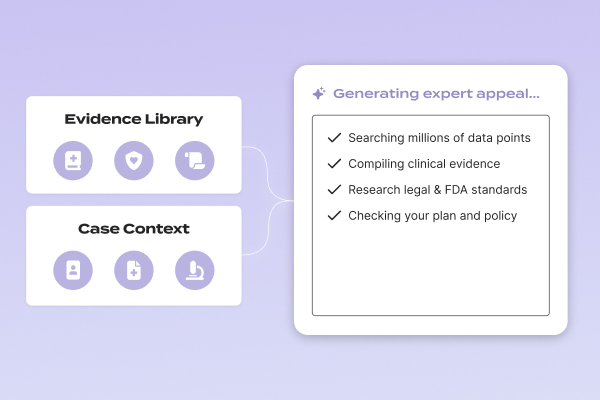
The system uses retrieval-augmented generation (RAG), which in practical terms means it doesn't generate arguments from general knowledge the way a tool like ChatGPT would. Instead, it searches a curated, verified database of clinical evidence, insurer policies, and legal standards, and pulls the specific sources that are relevant to your case. Every claim in your appeal is grounded in a citable source, not generated from patterns in internet text.
Here's what that looks like for your appeal: the AI identifies the clinical studies and treatment guidelines that support your prescribed treatment for your specific condition. It analyzes your insurer's own coverage policy to find where their denial conflicts with their stated criteria or with established medical standards. It identifies the federal and state laws that apply to your plan type and situation — including mandated timelines, required review processes, and your rights to escalate.
Then it synthesizes all of that into a single, coherent document that tells your story, presents the evidence, and makes the legal case — personalized to your diagnosis, your insurer, and the specific reason they denied your claim.
Built on expert strategy, not just trained on data
There's an important distinction between a general AI model that's been trained on internet text and a system purpose-built through actual domain expertise.
Claimable's AI wasn't built by feeding a model a batch of data and hoping for good results. The appeal strategy for condition and medication on the platform is designed by a person – a clinical and appeals expert who develops the approach the AI will take for each specific scenario. They determine what evidence is most persuasive, which insurer arguments to anticipate and counter, how to structure the case for maximum impact, and what legal and policy standards apply. The AI executes that strategy at scale, but the strategy itself gets hands-on refinement, testing, and vetting by a human before it ever touches a patient's case.
Claimable’s curated evidence database, spanning clinical studies, treatment guidelines, insurer coverage policies, and legal standards, was built through that same process. It's not a static dump of medical literature. It's an actively maintained body of evidence shaped by people who understand what actually wins appeals, organized so the AI can match the right sources to the right case. And it’s constantly being updated to make our appeals as strong as possible. When our platform detects something we don’t expect, like a denial that violates the law, it immediately flags it so the evidence body and appeal strategy can adapt in real time.
This is also how the platform avoids hallucination (the term for AI-generated content that sounds authoritative but is fabricated). Because Claimable's AI pulls from verified, curated sources rather than generating from general training data, every argument it makes is grounded in a real, citable source.
And our safeguards go further than sourcing alone. Once the AI generates a first draft, it runs through over a dozen evaluation criteria: cross-checking the appeal against the approved strategy for that condition, verifying that every clinical claim can be substantiated, confirming that legal citations are accurate and applicable to the patient's plan type, and flagging anything that doesn't meet the standard. The appeal that reaches you has been pressure-tested by the same system that built it.
How it improves with every case
Every appeal Claimable processes deepens the system's understanding of what works. Across thousands of real cases, the AI identifies patterns: which types of clinical evidence are most effective for specific denial types, how different insurers respond to different argument structures, which conditions have the highest overturn rates and why, and where particular insurers routinely deny claims that don't hold up on appeal.
This kind of systematic pattern recognition across a high volume of real outcomes is something no individual physician, attorney, or patient advocate can replicate, regardless of how experienced they are. A seasoned appeals specialist might handle a few hundred cases over a career. Claimable's AI draws on the accumulated knowledge from thousands, with each outcome refining what comes next.
The result is an 80%+ success rate, built on evidence that compounds.
Why AI is the right tool for this specific problem
Insurance appeals sit at the intersection of three complex, overlapping domains: clinical medicine, insurance policy, and law. Each one involves a vast and constantly evolving body of information. The task of synthesizing across all three — quickly, accurately, and for a single patient's specific case — is exactly the kind of information processing that AI handles better than manual effort alone.
A typical appeal, done manually, requires 15+ hours of research, writing, and review. Most physicians don't have that time. Most patients don't know where to start. Legal experts can charge thousands for the same work. Claimable compresses that into a process that takes minutes, without sacrificing the depth or rigor that makes an appeal effective.
Meanwhile, over 70% of large U.S. health insurers are already using AI in operations that include claims processing, according to the National Association of Insurance Commissioners. What that means? There’s an AI on the insurance side, trained and ready to find any opportunity to deny your claim. Patients facing those systems deserve access to tools that operate at the same level of sophistication — and that’s exactly what Claimable was built to do.
What the AI doesn't do
Claimable's AI is an administrative and legal tool. It builds the strongest possible argument for the care your doctor has already prescribed. It does not diagnose conditions, recommend treatments, or override your physician's clinical judgment.
You see everything before it's submitted. You approve the final appeal. Your doctor's input still matters, and a supporting letter from your physician paired with a Claimable-generated appeal often creates the strongest possible package.
If you're wondering whether your health data is safe throughout this process, we take that question seriously enough that we wrote a dedicated post about it covering what HIPAA compliance and SOC 2 Type II certification actually mean, how your data is protected, and how to evaluate any platform that handles health information. Read it here.
Claimable's AI-powered platform helps patients overturn insurance denials with an 80%+ success rate across 85+ conditions. If you've been denied coverage for a medication or procedure, start your appeal here.
Your doctor prescribed Remicade because your condition requires a powerful, proven biologic delivered directly into your bloodstream. Unfortunately, your insurer disagreed. If you’re feeling stuck, don’t be. This guide walks you through exactly how to push back and win.
Remicade (infliximab) has been treating serious autoimmune conditions since its initial FDA approval in 1998. It was the first TNF inhibitor ever approved by the FDA, and it remains a frontline therapy for Crohn’s disease, ulcerative colitis, rheumatoid arthritis, psoriatic arthritis, ankylosing spondylitis, and plaque psoriasis. Doctors prescribe it because it works, often when other treatments haven’t.
But insurers have been aggressively steering patients away from brand Remicade and toward biosimilars like Inflectra, Renflexis, and Avsola, and in many cases denying coverage for infliximab entirely until patients clear a gauntlet of prior authorization requirements.
Here’s what the insurance industry doesn’t expect: for you to fight back. Fewer than 1% of denied claims are ever appealed, which saves insurers billions every year. But that statistic reflects how confusing the process is, not how hopeless it is. When patients appeal with solid clinical evidence and the right strategy, overturn rates are dramatically higher. Claimable’s appeals succeed over 80% of the time in established conditions.
Remicade denials are more complicated than most because the drug triggers several types of coverage disputes at once, and the strategy for overturning one type looks nothing like another. This guide covers all of them.
Why Insurance Companies Deny Remicade Coverage
Before you respond to a denial, identify exactly what type you’re dealing with. The evidence you’ll need and the escalation strategy you follow depend entirely on the specific reason your insurer said no. Submitting the wrong type of response wastes time and can exhaust your limited appeal opportunities.
What Makes Remicade Denials Unique
Remicade sits at the intersection of several insurance pressure points that don’t apply to most medications. It’s an IV infusion billed through your medical benefit (not your pharmacy benefit), which opens the door to site-of-care restrictions and benefit-routing errors on top of standard coverage disputes. It has three commercially available biosimilars (Inflectra, Renflexis, and Avsola), and major insurers now require patients to try a biosimilar before they’ll cover brand Remicade. It treats six different autoimmune conditions with completely different step therapy rules. And dose escalation is common, especially for IBD patients, meaning your insurer may approve infliximab at one dose but deny the dose your doctor actually prescribed.
Understanding Your Denial
Denial letters are written in insurer language designed to sound final. They’re not. Here’s how to decode the most common denial types, what they actually mean for your situation, and where to start:
Biosimilar Switch and Formulary Change Denials
This is the denial type generating the most frustration right now. Your insurer isn’t saying you don’t need infliximab. They’re saying they’d rather pay for a different version of it.
Biosimilars are clinically similar to Remicade, and for patients starting infliximab for the first time, a biosimilar may work just fine. But switching a stable patient introduces real variables. Differences in formulation and manufacturing can affect how a biologic behaves in your body, and while clinical studies like the NOR-SWITCH trial have not confirmed increased immunogenicity from switching, the concern remains a recognized consideration in clinical practice. A 2025 study in Gastro Hep Advances found that IBD patients denied biologic therapy had worse clinical outcomes, higher hospitalization rates, and a trend toward more ER visits in the year following denial.
The arguments that win: documented adverse reactions to a biosimilar’s formulation or delivery, a history of disease flares or loss of response during prior medication switches, immunogenicity concerns supported by anti-drug antibody testing, and clinical stability on brand Remicade demonstrated by objective disease activity scores and lab values.
State protections worth checking: several states have enacted non-medical switching laws that may limit your insurer’s ability to force you off a stable biologic for purely cost-driven reasons. If your state has these protections, reference them directly in your appeal. (Related: How to Get a Non-Formulary Drug Covered)
Step Therapy Required
Step therapy is the insurer’s way of making you prove that cheaper options failed before they’ll pay for the one your doctor actually prescribed. For Remicade, that means failing on different drugs depending on your diagnosis:
The critical detail most patients miss: “failure” has a broad medical definition that works in your favor. Side effects, contraindications, and medical reasons a drug is inappropriate all count. Methotrexate, for example, is contraindicated in pregnancy and in patients with chronic liver disease. If a required step therapy drug isn’t appropriate for you, document that in your appeal.
The argument that wins: The 2025 ACG guidelines for Crohn’s disease explicitly recommend against the traditional step-up approach and support early use of advanced therapies, including infliximab, for moderate-to-severe disease. The ACR’s 2021 RA guidelines support biologic therapy for patients who don’t reach their treatment target on conventional DMARDs. Citing these puts the insurer’s demand for additional steps in direct tension with the clinical evidence.
Not Medically Necessary
This denial rarely reflects a thorough clinical judgment. It usually means the PA submission was too thin, and it’s one of the most commonly overturned denial types on appeal. A strong resubmission includes disease severity documented with objective measures (CDAI for Crohn’s, partial Mayo for UC, DAS28 for RA, PASI or BSA for psoriasis), prior failed therapies with specific dates and outcomes, and a clear clinical rationale for why Remicade is the appropriate next treatment.
Dose Escalation Denied
This denial is especially common for IBD patients. Over time, many Remicade patients need a higher dose (5 mg/kg to 10 mg/kg) or shorter intervals (every 6 or 4 weeks instead of 8). Dose optimization is standard clinical practice for TNF inhibitors, but insurers deny these adjustments anyway.
What your appeal needs: clinical evidence of loss of response (rising inflammatory markers, worsening endoscopy findings, increased disease activity scores), your prescriber’s rationale for the specific dose adjustment, trough level and anti-drug antibody testing if available, and references to the 2025 ACG guidelines, which specifically state that biologic dose optimization may be considered for patients with inadequate or loss of response.
Site of Care Restriction
This denial has nothing to do with whether you need Remicade. Insurers increasingly push patients away from hospital outpatient departments toward freestanding infusion centers or home infusion to reduce costs. If the alternative site can safely administer your infusion, transitioning may be the fastest path to continued coverage. But if you have a history of infusion reactions, the alternative facility isn’t equipped for your needs, or the logistics create access barriers, your doctor can submit a site-of-care exception documenting why your current setting is medically necessary.
Wrong Benefit or Administrative Error
Remicade is typically covered under the medical benefit, not the pharmacy benefit, because it’s administered by IV infusion in a clinical setting. Denials sometimes occur simply because the PA was routed to the wrong benefit or the billing codes were outdated.
Before you build a formal appeal, check the basics: Was the PA filed under the medical benefit? Were the correct HCPCS codes used (J1745 for Remicade, Q5103 for Inflectra, Q5104 for Renflexis, Q5121 for Avsola)? Is your infusion facility in-network? If the denial traces back to a routing or coding error, a corrected resubmission resolves it faster than a formal appeal.
How to Appeal a Remicade Denial (Step by Step)
Appeals work far more often than most people think. Insurance companies have spent decades conditioning patients to accept “no” as final. It’s not. When patients appeal with the right evidence and documentation, overturn rates are much higher.
Step 1: Read Your Denial Letter Carefully
Your denial letter is required by law to include the specific reason for denial, your appeal rights, and the deadline to file. Find the deadline first, because it’s the most time-sensitive detail.
Most commercial plans allow 180 days to file an appeal, but there are exceptions. UnitedHealthcare gives just 65 calendar days for many commercial plan types. Medicare Advantage plans follow CMS rules at 60 days. Missing your deadline forfeits your appeal rights regardless of how strong your case is, so move quickly.
Step 2: Know That You Can Appeal Yourself, Not Just Your Doctor
Your provider can and should appeal on the clinical side. But you also have the right to file your own appeal as the patient, and it runs on a separate track with its own protections: guaranteed response timelines, the right to external review by an independent third party, and multiple appeal levels. Use both tracks: your doctor makes the clinical case while you exercise your independent rights.
Step 3: Confirm Your Clinical Documentation Is Complete
Before building your appeal, run through the basics. Is the diagnosis coded correctly with the right ICD-10 codes for your specific condition? Are all required pre-treatment safety screenings (TB test, hepatitis B panel) documented and included? Was the prior authorization submitted under the medical benefit with the correct HCPCS codes?
For patients being switched off brand Remicade: has your doctor documented your clinical stability on the current medication with specific metrics? Disease activity scores, inflammatory markers (CRP, ESR, fecal calprotectin), endoscopy findings, and functional assessments all strengthen an appeal for continuity of care.
Step 4: Get a Letter of Medical Necessity
A letter of medical necessity from your prescribing physician is the single most important document in your appeal package. For Remicade, a strong letter should include your diagnosis with ICD-10 codes and current disease severity scores, your full prior medication history with specific reasons each therapy was stopped, the clinical rationale for Remicade at the prescribed dose and interval, and any safety considerations that affect the choice of infliximab product or infusion setting.
For biosimilar switch appeals, the letter should document your clinical improvement on brand Remicade with measurable outcomes. For dose escalation appeals, include trough levels, anti-drug antibody results, and objective evidence of loss of response at the current dose.
How to ask: be direct with your doctor. “My insurance denied Remicade. Would you be willing to write a letter of medical necessity for my appeal?” If your doctor’s office hasn’t written many of these, offering to share a template can improve the quality of the letter.
Step 5: Build Your Appeal Package
Your complete submission should include a cover letter, the letter of medical necessity, supporting clinical documentation (labs, visit notes, imaging, endoscopy reports, disease severity assessments), and a personal statement describing how the denial has affected your health and daily life. A winning appeal brings together three elements:
Your story. How your condition affects your ability to work, care for your family, and function day to day. If you’ve been stable on Remicade and are being forced to switch, describe what that stability has meant for your quality of life. Reviewers are people. Give them context that data alone can’t convey.
Clinical evidence. Reference authoritative guidelines that support your case: ACG guidelines for Crohn’s disease and ulcerative colitis, ACR guidelines for rheumatoid arthritis, AAD guidelines for psoriasis.
Policy and legal analysis. How your situation meets your plan’s own coverage criteria, relevant state non-medical switching laws if you’re being forced off a stable biologic, and federal protections like the ACA’s appeal and external review requirements. If the insurer’s denial contradicts their published criteria, call it out specifically.
Step 6: Submit and Track
Submit your appeal according to the instructions in your denial letter. Your insurer must respond within 30 days for a standard internal appeal, or within 72 hours for an expedited appeal when your health would be seriously jeopardized by waiting. For Remicade patients with active disease flares, an expedited appeal may be appropriate. Keep records of everything: submission method, date, confirmation numbers, and the name of anyone you speak with.
Step 7: Escalate If Needed
A denied internal appeal isn’t the end. You have the right to request an external review by an independent reviewer who has no relationship with the insurer. External reviewers evaluate the medical justification for your treatment, not whether the insurer wants to pay for it. These reviews are binding on the insurer in most states and regularly overturn denials that make it to this stage.
You can also file a complaint with your state’s Department of Insurance, explore additional legal options for employer-sponsored ERISA plans, or leverage state non-medical switching and step therapy exception laws. Don’t give up after one “no.” The system is designed to make you quit. Persistence is part of the strategy.
An Easier Path: Let Claimable Handle Your Remicade Appeal
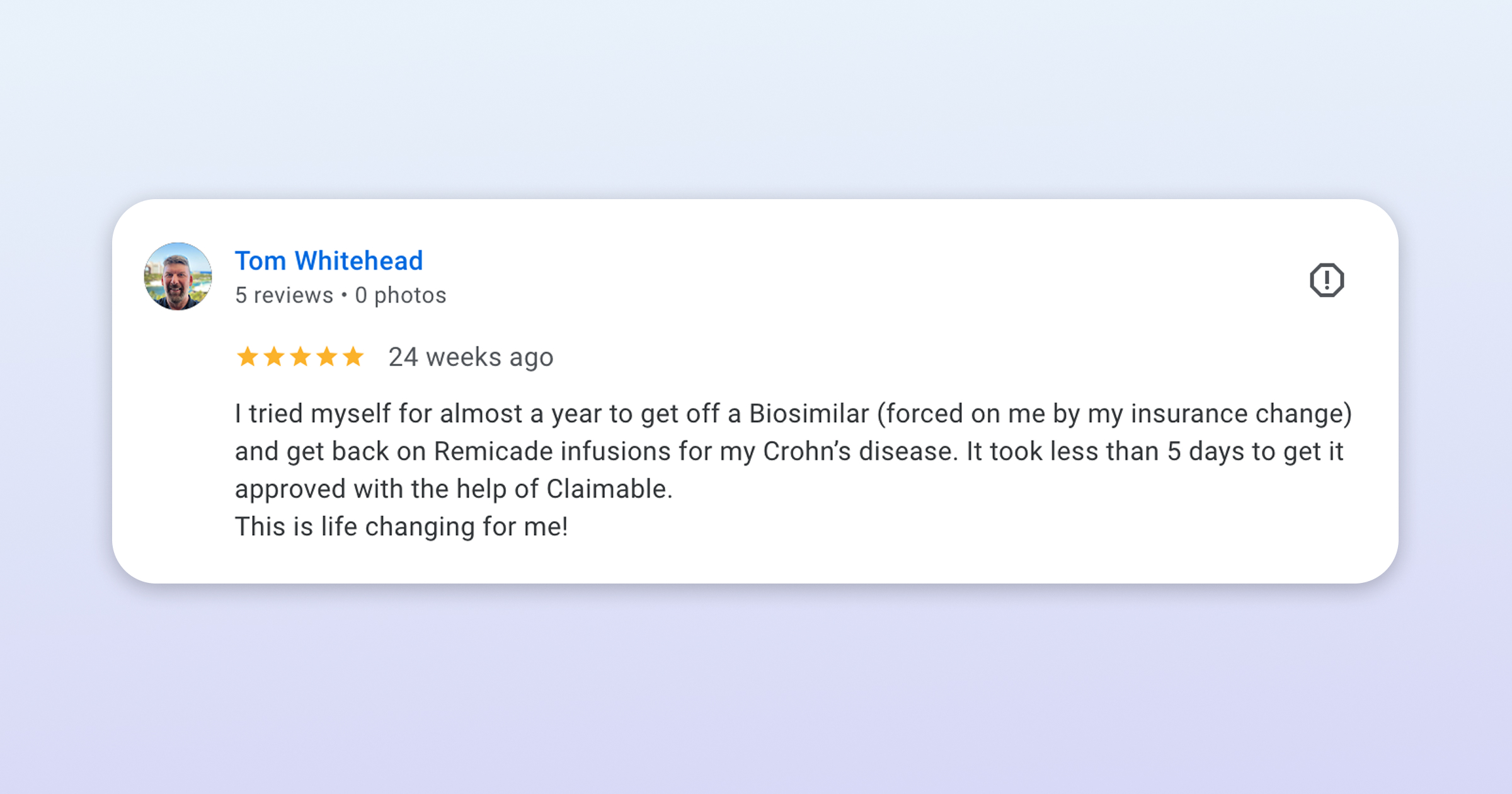
If navigating this process feels overwhelming, Claimable can help. You answer a few questions about your Remicade denial and medical history, and we build a fully customized appeal using our database of millions of clinical studies, insurer policies, and legal standards. The appeal includes your personal narrative, clinical evidence matched to your condition and denial type, and a legal analysis targeting your insurer’s reasoning. We submit directly to your insurer and guide you through escalation if needed.
Thousands of biologic appeals have taught us how each major insurer operates and which arguments win for each Remicade denial type.
Appealing with Claimable costs $39.95. No success fees, no hidden costs. When Remicade can cost $4,000 to $7,000 per infusion without coverage, the math is simple.
Appeal Timelines: How Long Does a Remicade Appeal Take?
Typical timelines for each stage of a Remicade insurance appeal.
The single biggest factor in speed is completeness. Appeals that include everything from the start move faster than submissions that trigger back-and-forth requests for additional information. The average Claimable appeal gets a response in just 10 days.
FAQs
Why was my Remicade denied if my doctor prescribed it?
A prescription and an insurance approval are two different things. Most plans require prior authorization for Remicade, and PA criteria often include step therapy requirements, biosimilar preference mandates, site-of-care restrictions, and documentation thresholds that go well beyond a standard prescription order. Your doctor made a clinical decision. The insurer is applying a separate, more restrictive set of rules.
Can I appeal a Remicade denial myself, or does my doctor have to do it?
You can appeal yourself. Patient-initiated appeals are a separate process from provider appeals, and they carry their own legal protections including mandated response timelines and the right to external review. If your doctor’s prior authorization was denied, your patient appeal is an additional opportunity, not a duplicate.
What if my insurer wants me to switch to a Remicade biosimilar?
It depends on your clinical situation. If you’ve been stable on brand Remicade and have documented reasons why switching poses risk (adverse reactions, disease flares during prior switches, immunogenicity concerns), that’s a strong case for a formulary exception. If you haven’t tried a biosimilar and don’t have a clinical contraindication, trying the preferred biosimilar may be the fastest path to continued treatment.
My insurer denied my dose increase for Remicade. What can I do?
Dose escalation and interval shortening are standard clinical practice for Remicade, especially in IBD, and the 2025 ACG guidelines specifically support dose optimization. Your appeal should include objective evidence of loss of response at the current dose, trough levels and antibody testing if available, and your prescriber’s clinical rationale for the adjustment.
What’s the difference between Remicade and Humira?
Both are TNF inhibitors used for many of the same autoimmune conditions, but they differ in important ways. Remicade (infliximab) is given by IV infusion at a medical facility, typically every 6–8 weeks, and billed under the medical benefit. Humira (adalimumab) is a self-administered subcutaneous injection billed under the pharmacy benefit. That billing distinction means they face different denial types and different appeal pathways.
How much does Remicade cost without insurance?
Remicade typically costs between $4,000 and $7,000 per infusion, depending on your weight, dose, and infusion site. Biosimilars cost less. Johnson & Johnson offers the J&J withMe Savings Program for commercially insured patients, which can reduce costs to as little as $5 per infusion.
Is it worth appealing a Remicade denial?
Almost always, yes. Treatment gaps with Remicade carry real clinical consequences: disease flares, loss of response, and the potential development of antibodies that can make the medication less effective if restarted. Research confirms that IBD patients denied biologic therapy have worse outcomes and more hospitalizations. Fewer than 1% of denials are ever challenged, and insurers have built their entire denial infrastructure around that number. Your doctor prescribed Remicade because you need it. The appeal puts that reasoning in front of someone who has to evaluate it on the merits.
Claimable’s physician-led team has helped patients recover over $30 million in care access by fighting insurance denials. We’re SOC 2 Type II certified and HIPAA compliant. Learn more about how Claimable works →
Getting denied coverage for Humira is disorienting because the denial could mean very different things depending on your situation.
If you're a new patient, it likely means your insurer wants you to try cheaper alternatives first. If you've been stable on Humira for months or years, it might mean your insurer removed it from the formulary entirely and is pushing you toward a biosimilar you never asked for. And while biosimilars are clinically similar to Humira, "similar" doesn't mean identical — some patients experience differences in side effects, delivery devices, or how well the medication controls their condition.
Since 2024, all three major pharmacy benefit managers have been removing brand-name Humira from their commercial formularies. CVS Caremark dropped it in April 2024. Express Scripts followed for 2025. OptumRx did the same. In their place: biosimilars like Hyrimoz, Amjevita, Cyltezo, and Hadlima. The result is a wave of denials that simply didn't exist two years ago.
The good news is that you can appeal, and appeals work far more often than most people realize. The right approach depends on which type of denial you're facing. And because Humira is approved for so many conditions — rheumatoid arthritis, Crohn's disease, psoriasis, and more — the step therapy requirements can vary dramatically depending on your diagnosis.
This article explains why your Humira coverage was denied, how to match your denial type to the right response, and what to include in an appeal that actually gets results.
Why Insurance Denies Humira Coverage
Before you do anything else, identify the specific reason your insurer denied coverage. The denial reason determines your entire appeal strategy, and submitting the wrong type of response wastes time and can exhaust your limited appeal opportunities.
Broadly, Humira denials fall into two camps: patients who are already stable on Humira and are being forced onto a biosimilar, and new patients trying to get coverage for the first time. Both face real barriers, but the barriers are different, and so are the solutions.
What Makes Humira Denials Different from Other Medications
Humira is approved for nine or more autoimmune disorders, including rheumatoid arthritis (RA), psoriatic arthritis, ankylosing spondylitis, Crohn's disease, ulcerative colitis, severe chronic plaque psoriasis, severe hidradenitis suppurativa, uveitis, and juvenile idiopathic arthritis. Each condition has completely different step therapy requirements. A denial for a Crohn's patient and a denial for a psoriasis patient may use identical language but require totally different appeal strategies. A blanket response that doesn't address your specific condition's requirements will almost certainly fail.
Humira is also a biologic, not a pill. That means safety screenings — a TB test, a hepatitis B panel — are required before treatment can start. Missing or incomplete lab results are one of the most common and most preventable reasons for Humira prior authorization denials. If your denial traces back to missing screenings, you may not need a formal appeal at all. A corrected resubmission with the lab results included can resolve it.
And then there's the biosimilar shift. Many Humira denials in 2025 and 2026 aren't about whether you need adalimumab. They're about whether your insurer will pay for the brand-name version or require you to use a lower-cost alternative. When your insurer removes Humira from its formulary and replaces it with Hyrimoz or Amjevita, that's a business decision, not a medical one.
The Denial Types You're Most Likely to Encounter
Most articles about Humira denials list reasons using the language insurers put in their letters. That's not especially helpful. What matters is what the denial actually means for you and how it shapes your next move.
A note before you start building your appeal: not every denial requires one. If your denial traces back to a correctable administrative error — missing safety screenings, an incorrect ICD-10 code, or an outdated billing code — a corrected resubmission is often faster and more effective than a formal appeal. One common billing issue right now: the HCPCS code for adalimumab changed from J0135 to J0139 as of January 2025. If your provider's billing system hasn't been updated, that alone can trigger a denial.
Formulary Change and Biosimilar Switch Denials
This is the denial type driving the most confusion and frustration right now. If you've been stable on Humira and received a letter saying it's no longer on your plan's formulary, you're not alone.
CVS Caremark removed brand Humira from its major national commercial formularies in April 2024, replacing it with biosimilars. Express Scripts did the same beginning in 2025, and OptumRx followed with its own biosimilar-first strategy. The practical effect: millions of patients who had stable coverage woke up to letters telling them their medication was no longer preferred.
The insurer's position isn't irrational. Biosimilars are clinically similar to Humira, and for many patients, switching works fine. But "many patients" isn't all patients. A 2026 analysis of Truveta electronic health record data found that among patients who switched from brand Humira to a biosimilar, 13.2% ultimately switched back to the original. Nearly 40% of those switchbacks happened within 30 days, suggesting early dissatisfaction, side effects, or problems with the transition.
If you have a clinical reason for staying on brand Humira, the strongest arguments for a formulary exception include: adverse reactions to a biosimilar's inactive ingredients or delivery device, a documented history of disease flares during medication switches, immunogenicity concerns such as developing antibodies during transitions, and adherence and consistency factors for chronic conditions where stability matters.
It's also worth knowing that manufacturer support programs are evolving alongside this biosimilar transition. AbbVie's patient assistance landscape for Humira is shifting as biosimilars become the standard formulary option, which makes understanding your appeal rights more important than ever. If copay support that previously helped cover your costs is changing, an approved appeal that restores insurance coverage is the most reliable path forward.
Step Therapy Required (Conventional Medications)
Step therapy means your insurer requires you to try and fail on older, cheaper medications before approving Humira. Even when your doctor has clinical reasons for prescribing it directly.
What makes this especially complicated for Humira is that step therapy requirements are completely different depending on your diagnosis. A rheumatoid arthritis (RA) patient typically needs to fail on one or two conventional DMARDs like methotrexate. A plaque psoriasis patient may need to fail topical agents and a conventional systemic. A patient with ankylosing spondylitis usually needs to try two or more NSAIDs first. Knowing what your insurer expects for your specific condition is essential before you build your appeal.
"Failure" doesn't always mean the drug didn't work. Side effects, contraindications, and medical reasons a drug is inappropriate all count. Methotrexate, for example, is contraindicated in pregnancy and may not be safe for patients with liver disease. If your doctor knows you can't take a required step therapy drug, that should be documented clearly in your appeal rather than forcing you through a trial that's medically inappropriate.
When an insurer demands you fail on conventional therapies before accessing Humira, they may be contradicting leading medical society guidance. The American College of Rheumatology's 2021 guidelines for RA support biologic therapy for patients who don't achieve their treatment target on conventional DMARDs like methotrexate. If you've already tried and failed the medications your insurer's step therapy requires, citing these guidelines puts the insurer's demand for additional steps in tension with the clinical evidence. The 2025 American College of Gastroenterology guidelines for Crohn's disease go further, explicitly recommending against the traditional step-up approach and supporting early use of advanced therapies for patients with moderate-to-severe disease. Citing these guidelines in your appeal is a powerful argument at any stage of the process.
Biosimilar Step Therapy
This is distinct from conventional step therapy. Here, the insurer will cover adalimumab — they just want you to try a preferred biosimilar (typically Hyrimoz, Amjevita, or Cyltezo) before brand Humira.
The practical question is straightforward: is there a clinical reason you specifically need the brand? If you've been stable on brand Humira and have documented reasons why switching poses risk — adverse reactions, immunogenicity concerns, prior failed switches — then document those reasons thoroughly and appeal. If you haven't tried a biosimilar and don't have a clinical contraindication, trying the preferred biosimilar may be the fastest path to treatment.
PA Requirements Not Met (Not Medically Necessary)
This denial often means the initial submission was too thin, not that the insurer fully reviewed your case and made a considered medical judgment. Common gaps include not specifying disease severity with objective measures (DAS28 scores for rheumatoid arthritis, CDAI for Crohn's, PASI or BSA for psoriasis), not listing prior failed therapies with dates and specific outcomes, and not explaining how your symptoms and disease progression make Humira the appropriate next step for your situation.
Because Humira treats so many conditions, the documentation requirements differ by diagnosis. A prior authorization that doesn't clearly link your specific condition, its severity, your treatment history, and the insurer's criteria for that indication will almost always trigger this denial. The fix is usually more thorough documentation, not a different argument.
How to Appeal a Humira Denial (Step by Step)
Appeals work far more often than most people think. Insurance companies have spent decades conditioning patients to accept "no" as final. It's not. Fewer than 1% of insurance denials are ever appealed, and insurers count on that. When patients do appeal with the right evidence and documentation, overturn rates are significant.
Step 1: Read Your Denial Letter Carefully
Your denial letter is required by law to include the reason for denial, your appeal rights, and your deadline to appeal. Read it closely and identify which denial type from the table above matches your situation. If anything in the letter is unclear, you have the right to request and review your full claim file from your insurer.
Pay close attention to your deadline. Most commercial insurance plans allow 180 days to file an appeal, but UnitedHealthcare gives just 65 calendar days for commercial plan member-initiated appeals — the shortest window among major insurers. Medicare Advantage plans follow CMS rules at 60 days. Missing your deadline forfeits your appeal rights regardless of how strong your case is.
Step 2: Understand That You Can Appeal — Not Just Your Doctor
Many patients assume their doctor has to handle the appeal. Your doctor's prior authorization or provider appeal is one process. Your patient-initiated appeal is a separate process with its own protections. Here's why you should appeal yourself, not just leave it to your doctor.
Patient appeals carry stronger legal protections than provider appeals: mandated response timelines, the right to external review by an independent third party, and multiple levels of appeal. If your doctor's PA was denied, your appeal is a separate opportunity. Use it.
Step 3: Confirm Your Clinical Documentation Is Complete
Before building your appeal, run through the basics. Is the diagnosis coded correctly with current ICD-10 codes for your specific indication? Are all required safety screenings (TB test, hepatitis B panel) documented and included? Is the billing code current (J0139 as of January 2025, not the old J0135)?
For patients being switched off brand Humira: is your doctor willing to document your clinical stability on the current medication with specific metrics? Disease activity scores, lab values, and functional assessments all strengthen an appeal for continuity of care.
If the issue is a correctable administrative error, a resubmission may resolve it without a formal appeal, and it's faster.
Step 4: Get a Letter of Medical Necessity
This is the single most important document in your appeal. A strong letter of medical necessity from your prescribing physician should include your diagnosis with ICD-10 codes and current disease severity scores, your full prior medication history with specific reasons each therapy was stopped (inefficacy, side effects, contraindications), and clear clinical rationale for why Humira is the appropriate treatment.
For biosimilar switch appeals specifically, the letter should also document your clinical improvement on brand Humira with measurable outcomes and explain why switching introduces risk for your situation.
If your doctor hasn't written one before or seems unsure what to include, be direct. Offer to provide an outline of what insurers typically look for, or review how to talk to your doctor about a denial so you're prepared for the conversation. Many physicians are willing to write a strong appeal letter but don't always know the specific documentation that moves the needle with insurance reviewers.
Step 5: Build Your Appeal Package
A complete appeal package brings together four components:
Your cover letter states what you're appealing, which denial you're responding to, and what outcome you're requesting.
Your letter of medical necessity from your physician provides the clinical backbone.
Your clinical documentation includes relevant medical records, lab results, imaging, and disease severity assessments. Reference authoritative peer-reviewed clinical guidelines where they support your case: ACR guidelines for rheumatoid arthritis, AGA guidelines for Crohn's disease and ulcerative colitis, AAD guidelines for psoriasis and hidradenitis suppurativa.
Your personal statement explains how the denial affects your daily life, your health, and your ability to function. This is where you tell your story in your own words. Insurers are required to consider all submitted evidence during an appeal, and a clear personal narrative about the real-world impact of losing your medication adds weight that clinical documents alone can't provide.
Together, these form the three pillars of a winning appeal: your story, the clinical evidence, and the policy and legal analysis that shows your situation meets the plan's own criteria.
Step 6: Submit and Track
Submit your appeal according to the instructions in your denial letter. Your insurer must respond within 30 days for a standard internal appeal, or within 72 hours for an urgent or expedited appeal (when your health would be seriously jeopardized by waiting).
Keep records of everything: your submission method, date, confirmation numbers, and the name of anyone you speak with. If you submit by fax, keep the transmission confirmation. If you mail it, use certified mail with return receipt. If you don't receive a response within the required timeframe, here's what to do if you haven't heard back about your appeal.
Step 7: Escalate If Needed
If your internal appeal is denied, you have the right to an external review by an independent third party. This is a reviewer who evaluates the medical justification for your treatment, not whether the insurer wants to pay for it. External reviews are binding on the insurer in most states.
Some states also have additional protections worth knowing about. Several states have step therapy exception laws, and a growing number have enacted protections related to non-medical switching of biologic therapies. Check whether your state offers these protections before assuming you've exhausted your options.
Don't give up after one "no." The appeals process is designed with multiple levels for a reason. Persistence is part of the strategy, and each level of appeal brings a fresh set of eyes to your case. If you're feeling discouraged, here's why you shouldn't give up after a denied appeal.
An Easier Path: Let Claimable Handle Your Humira Appeal
If navigating this process feels overwhelming, or you don't have the time to research insurer policies and build a clinical case from scratch, Claimable can handle it for you.
Here's how it works:
- Answer a few questions about your Humira denial and medical history.
- We build your case using our database of millions of clinical studies, insurer policies, and legal standards.
- We create a fully customized appeal package with your personal story, clinical evidence, and policy analysis.
- We submit it for you — faxed and mailed directly to your insurer.
- We guide you through escalation if needed.
Over 80% of Claimable appeals succeed, with most cases resolved in 10 days or less.
Appealing with Claimable for Humira costs $39.95. No success fees, no hidden costs, just a flat fee. When brand Humira can cost nearly $7,000 per month without insurance coverage, the math is simple.
Appeal Timelines: How Long Does a Humira Appeal Take?
Typical timelines for each stage of the Humira insurance appeal process.
The faster you submit a complete, well-documented appeal, the faster you'll get a decision. The average Claimable appeal gets a response in just 10 days.
Frequently Asked Questions
Why was my Humira denied if my plan used to cover it?
Since 2024, all three major pharmacy benefit managers — CVS Caremark, Express Scripts, and OptumRx — have removed brand Humira from their commercial formularies in favor of lower-cost biosimilars. Your plan may still cover adalimumab, but the prior authorization process for the brand-name version now typically requires a formulary exception with clinical justification. "Covered" and "approved without a fight" are no longer the same thing for Humira.
Can I appeal a Humira denial myself, or does my doctor have to do it?
You can appeal yourself. Patient-initiated appeals are a separate process from provider appeals, and they carry their own legal protections including mandated response timelines and the right to external review. If your doctor's prior authorization was denied, your patient appeal is an additional opportunity, not a duplicate.
What if my insurer wants me to switch to a Humira biosimilar?
It depends on your clinical situation. If you've been stable on brand Humira and have documented reasons why switching poses risk — adverse reactions to a biosimilar, disease flares during prior medication changes, immunogenicity concerns — that's a strong case for a formulary exception. If you haven't tried a biosimilar and don't have a clinical contraindication, trying the preferred biosimilar may be the fastest path to treatment. Either way, understanding your options before responding to the denial is important.
My insurance changed my Humira coverage mid-year. Is that legal?
Insurers can update their formularies, and many did so aggressively in 2024 and 2025 as biosimilar competition expanded. However, some states have enacted step therapy protections and non-medical switching restrictions that may limit an insurer's ability to force patients off stable biologic therapy for purely cost-driven reasons. Check whether your state has these protections, and reference them in your appeal if applicable.
Is it worth appealing a Humira denial?
Yes. Fewer than 1% of insurance denials are ever appealed, and insurance companies count on patients accepting the initial "no." But when patients appeal with proper clinical documentation, clear evidence of medical necessity, and an understanding of their legal rights, overturn rates are significant. The process takes effort, but the alternative — abandoning a treatment that manages a serious chronic autoimmune disorder — carries real health consequences.
Claimable's physician-led team has helped patients recover over $30 million in care access by fighting insurance denials. We're SOC 2 Type II certified and HIPAA compliant. Learn more about how Claimable works →
Let's get you covered.